The marriage between composer and ethnomusicologist in Béla Bartók’s creative musical output
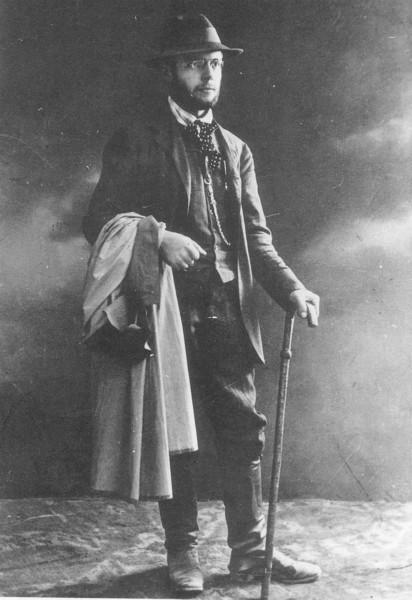
Béla Bartók on his field trip to Transylvania, 1907.
“In our case it was not simply a question of recovering an individual melody, treating it in the traditional manner and building it into our composition. […] This would have resulted in mere copy work and would never have led to a new unified solution. Our task was to understand the inner spirit of this hitherto unknown music and create a new musical style based on the essentially inexpressible spirit.”
(Béla Bartók. Hungarian Folk Music and Modern Hungarian Music, 1928)
Introduction
In 1899, despite being offered a place at the prestigious Vienna Conservatory, Béla Bartók chose to stay in Hungary and study at the Budapest Academy. This decision was informed by the composer’s lifelong concern with national identity which had a decisive effect on his musical development. Bartók’s nationalism encouraged him to search for new modes of expression which were derived from his exploration into the musical heritage of his native Hungary. The originality of Bartók’s music lies in the fact that he absorbed folk influences into his personal compositional process. This was achieved, not by assimilation of the material entity or surface features of folk music, but what Bartok often referred to as the “spirit” or “essence” of the music. Bartok’s method involved the detailed examination of the melodic and rhythmic characteristics of peasant tunes, in an effort to discover their intrinsic nature. In Bartók’s hands, folk music gave rise to new melodic, rhythmic and harmonic possibilities, which formed the basis of his uniquely individual style.
The primary objective of this paper is to show how certain compositional techniques, achieved through the transcription and analysis of folk music, were transplanted into Bartók’s creative musical language. I will examine some of the main features of folk song style, comparing them to techniques used in the arrangement of folk music and the composition of original music.
Chapter One will provide social and contextual background to Bartók’s early works. It will describe how Bartók used Liszt as an early compositional model, synthesising stylistic features of Hungarian Verbunkos music with the Romantic musical idiom.
Chapter Two will give an account of Bartók’s discovery of authentic folk music and his subsequent ethnomusicological study in Hungary and neighbouring nations. I will describe Bartók’s means of classifying material, which formed the basis of his comparative, ethnographic approach.
Chapter Three will concentrate on the entry of folksong, in the form of harmonic arrangements, into the art-music tradition. It will discuss Bartók’s views on the limited harmonic implications of folk melody, and the possibilities of deriving a new harmonic language from the linear intervallic characteristics of modal and pentatonic melodies. I will demonstrate Bartók’s avoidance of tonal function with the use of chords and scales derived from folk music. With reference to Bartók’s three-level concept of folk music arrangement, I will examine how he derived more elaborate accompaniments, which shifted emphasis from the tune itself to the total effect of presentation. This chapter will be confined to analysis of settings of folk material in early vocal and piano collections.
Chapter Four will examine how Bartók extended folk music qualities into the more abstract language of his original musical compositions. By looking at his early piano repertoire, I will examine his use of polymodal scale combinations to create a twelve-note chromatic environment with a single fixed point of reference. This will involve examination of the use of intervallic pitch cells as a means of evading traditional tonal connotations and also providing a sense of harmonic coherence.
The focus of Chapter Five will be on Bartók’s synthesis of disassociated musical elements, variational procedures and structural considerations. It will adopt a broader approach covering a larger range of Bartók mature works. My argument will show, in reference to later arrangements and original works, his more unified approach to the use of folk music within a larger structural framework. This chapter will isolate some of the various components of musical expression, showing the influence of several diverse elements drawn from a broad cross-section of Bartók’s folk music research.
In concluding, I will emphasise the value of an analytic method informed by a thorough knowledge of Bartók’s folk music interests.
Chapter 1: The Verbunkos Tradition and Early Nationalism
Turn-of-the-century Hungary
One of the main achievements of the Hungarian War of Independence, 1848-1849, was the abolition of serfdom and the emergence of a new social ideology influenced by the events of the French Revolution. In 1867, Hungary established a duellist division of power between the Habsburg Empire and the Hungarian nobility. The compromise of 1867 established Franz Joseph I as the joint monarch of Austria and Hungary. Hungary was granted an independent government, ruling local and national affairs. This situation created a new constitutional order, which was controlled by the aristocracy and middle nobility. Judit Frigyesi points out that, as the result of the abolition of feudal privileges, the landless gentry dominated the bureaucracy of local government, adopting a patriotic ideology, regarding the nobility as the true embodiment of the Hungarian nation.
Out of an almost mystical belief in the legitimising power of the conquest of Hungary arose the idea that the supremacy of the nobility was “natural” and “in accordance with the genuine Hungarian spirit.”1
This mode of government preserved a quasi-feudal economic and social system, which maintained a polarized society between the nobility on the one hand, and a largely underprivileged peasant class on the other.
Towards the end of the nineteenth century Hungarian society was influenced by a rising tide of national consciousness, which expressed itself in an increasing anti-Austrian sentiment. Frigyesi points out that it was the middle nobility (gentry), who monopolised these concepts of patriotism, proclaiming itself the true prototype of the Hungarian people.
Instead of the peasantry, the gentry passed for the best guardians of national identity. The real character of the peasants had no place in this concept of Hungarianness. As a class, the peasants were of little importance in public life, and the peasant question was believed to have been solved forever with the abolition of serfdom. Yet, in reality, the lifestyle and standard of living of the peasantry had hardly changed.2
This self-aggrandising nationalism dominated official art and literature, creating a hierarchical and chauvinist social order. Against this background a younger generation of artists like Bartók made a radical break with the past, adopting an outlook that embraced modernistic ideals, which became essential for continued artistic creativity.
Social change at the turn of the century was influenced not only by nationalism, but also by the rapid rate of industrialisation, urbanisation and population growth. Mary Gluck points out that Bartok came to maturity in a “society undergoing rapid, even cataclysmic, social, economic and political transformation.”3 A growth of twenty per cent in the population of Hungary occurred between 1890 and 1910, with an increase in the numbers employed in industry, by seventy-five per cent.4 The disposition of population in Hungary’s towns was transformed, and the urban population increased from fourteen per cent in 1867, to one quarter of the overall population by 1913.5 This was influenced by developments in Hungary’s infrastructure, which progressed at a fast pace towards the end of the nineteenth century.
Hungary, at the turn-of-the-century, was a multi-ethnic society, in which Hungarian speakers were the largest of a number of distinct ethnic groups. Hungary’s rural provinces contained large Romanian, Slovak and Slavic ethnic peasant groups. Jews and Germans integrated themselves into Hungary’s urban society, rising into the middle classes, undergoing a large-scale assimilation, which often involved adopting Hungarian nationality. This furthered the division between the urban middle classes and the rural population, who occupied what Miklós Lackó calls the “under nation” position in society.6
Hungarian Musical Tradition
In her essay, Frigyesi writes that the Hungarian nobility “transmitted the cultural-ideological trends of the West, while at the same time it developed a distinct ‘national’ culture.”7 She goes on to describe how the middle nobility adopted the music of the Gipsy band as the preferred form of musical expression.
Stephen Erdely shows how dissimilar types of music corresponded to different layers of Hungarian society.
(1) The upper classes (which included the nobility, the urban fanciers, industrialists and bourgeoisie) turned to the west for their needs.
(2) The gentry and the urban middle classes found satisfaction in the music of gypsy bands and popular art songs
(3) Agrarian folk who lived with its folksong and musical custom isolated from the rest of the country.8
The musical favoured by the gypsies and adopted by the gentry, can be divided into two main forms, verbunkos and Magyar nóta (Hungarian tune). These permeated all Hungarian musical traditions of the eighteenth and nineteenth centuries.
The verbunkos (derived from the German word Werbung) was a recruiting dance used by the Habsburg army between the years of 1715 and 1849. The music, which was performed by Gipsy bands in a spectacular display of virtuosic leaps and clicking of heels, was used to entice young men into military service.9 It was comprised of two sections, a slow Lassú and a fast Friss. Bálint Sárosi points out that the term Verbunkos was applied later “as a musical indicator of the whole period.”10 In earlier times Verbunkos was known as the Magyar, which was also linked to civilian dance forms such as the Allemande, Anglaise, Française and Polonaise.11 Its musical characteristics are marked by a characteristic dotted rhythm and fast virtuosic ornamentation. In his New Grove article, Johnathan Belman gives the following examples of Verbunkos from an edition of Hungarian dances for clavichord.
Ex. 1.1: Magyar tántzok klávikordiomra válok, Vienna 1790.
Adagio (lassan)

Allegro (frissen)

Verbunkos music was considered to have originated from folk music sources that were adapted to suit the gypsy temperament. Bellman writes:
Although the Verbunkos is sometimes considered to be Gypsy music, it was actually Hungarian, often derived ultimately from the song repertory, but played in a fashion characteristic of the gypsy musician.12
In the late eighteenth century, Hungarian music was influenced by trends that emerged from Viennese classicism. Amongst the many Verbunkos composers were the names of assimilated foreigners who introduced Western musical elements into Hungarian music. It was the influence of Western music, which was responsible for the introduction of aspects like functional harmony and chordal accompaniment. Zoltan Kodály states that:
It was town art-music, in essence nothing but dance music; at first it was even written by foreigners and immigrants, and like its later counterpart, was to be found in print.13
It was during this period that Hungarian music was transformed into a new instrumental style for middle-class consumption, represented by its best-known exponents, the violinists János Lavotta (1764-1820), Mark Rozsavölgyi (1789-1824) and János Bihari (1764-1827). Contemporary accounts describe the manner in which Verbunkos was portrayed as the true manifestation of Hungarian national consciousness. Sárosi describes how Verbunkos music was used to embody a sense of “nation” that excluded other layers of society.
The representative of this period largely did not recognize the music of the Hungarian people as being characteristic of the “Hungarian nation”—that is, the noble and very slender upper class layer — indeed they simply refused to consider the existence of folk music.14
The Magyar Nóta (Hungarian tune) was a mid nineteenth century phenomenon, and was largely the creation of middle-class composers of noble descent. These popular songs were often transmitted orally, as folk songs, without the name of an associated composer attached. Erdely points out that the songs were intended “to provide the growing urban population with songs resembling folksongs but ‘on a higher level’.”15 The songs were disseminated in urban areas and performed by Gipsy bands. Erdely describes how the general public regarded these songs “as being the true Hungarian tune and gypsy music tradition.”16 In this nationalist ideology, music was exploited to promote the patriotism of the gentry and urban middle classes, who were completely unconcerned with the genuine musical tradition of the Hungarian peasant.
Sárosi describes harmonic features of the Magyar nóta, which distinguish it from genuine Hungarian folk music.
Its main distinctive feature is its strong harmonic base: the turns of melody virtually dictate the accompanying chords — the chord sequences and accompaniment clichés well known from gypsy orchestras. Such accompaniments are inconceivable with folk songs, especially the old-style ones.17
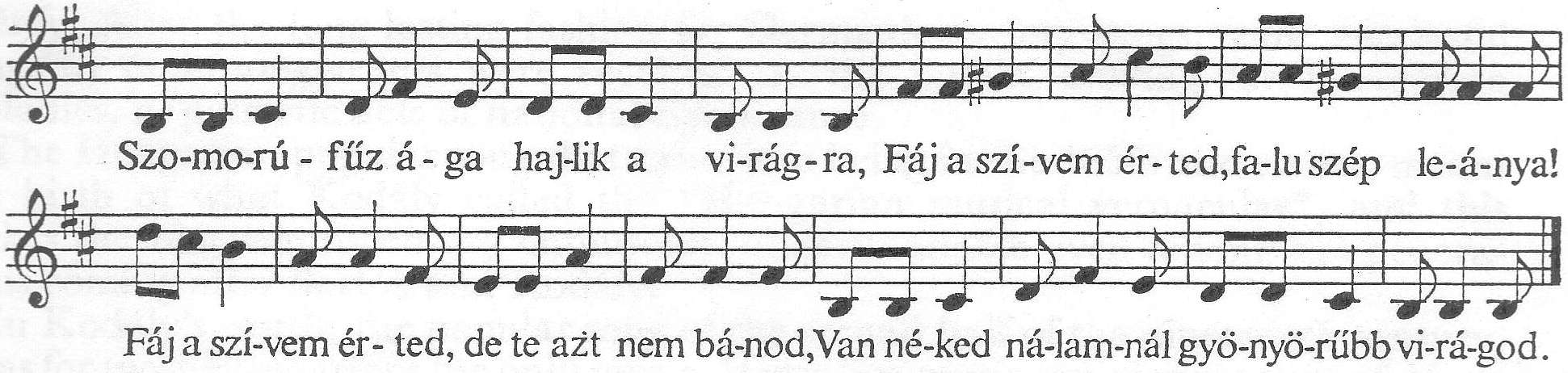
The following example, by the composer Kálmán Simonffy (1831-188), demonstrates melodic features, which support a conventional harmonic structure.
Ex. 1.2: Magyar Nóta: Szomorúfűz ága hajlik a virágra.18
In spite of its urban origins, the Magyar nóta permeated the music of rural villages, where it was assimilated into an orally transmitted folk tradition. Variants of popular song were responsible for the creation of new forms of folk music that began to displace the older tradition. Kodály points out that “the tunes became common property soon after their appearance and nobody inquired into their origin.”19 The common misconception of the origin of Hungarian music at the turn-of-the-century was that the Magyar nóta represented the indigenous culture of both the Hungarian and the Gipsy peoples. It was not until the twentieth century that these claims were invalidated by Bartók and Kodály’s ethnomusicological research.
Verbunkos was also transplanted into the nineteenth century art-music in the works of Hungarian Romantics such as the opera composer Ferenc Erkel and instrumental composer Milhály Mosonyi. However, it was with Liszt’s Hungarian Rhapsodies and Brahms’ Hungarian Dances that so-called Hungarian music reached its widest audience.
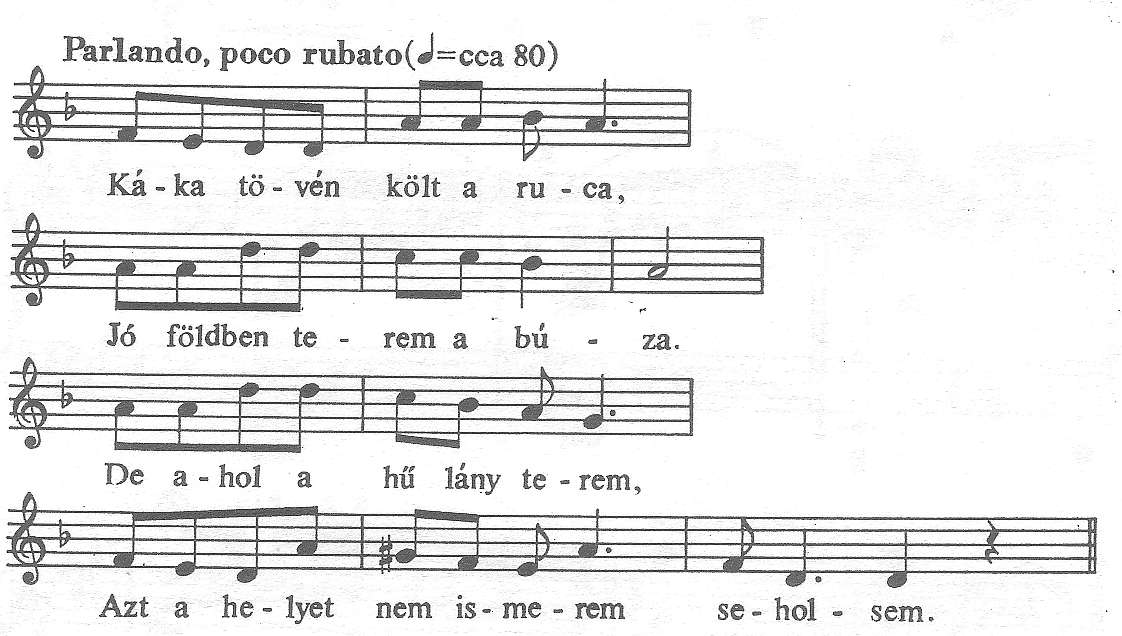
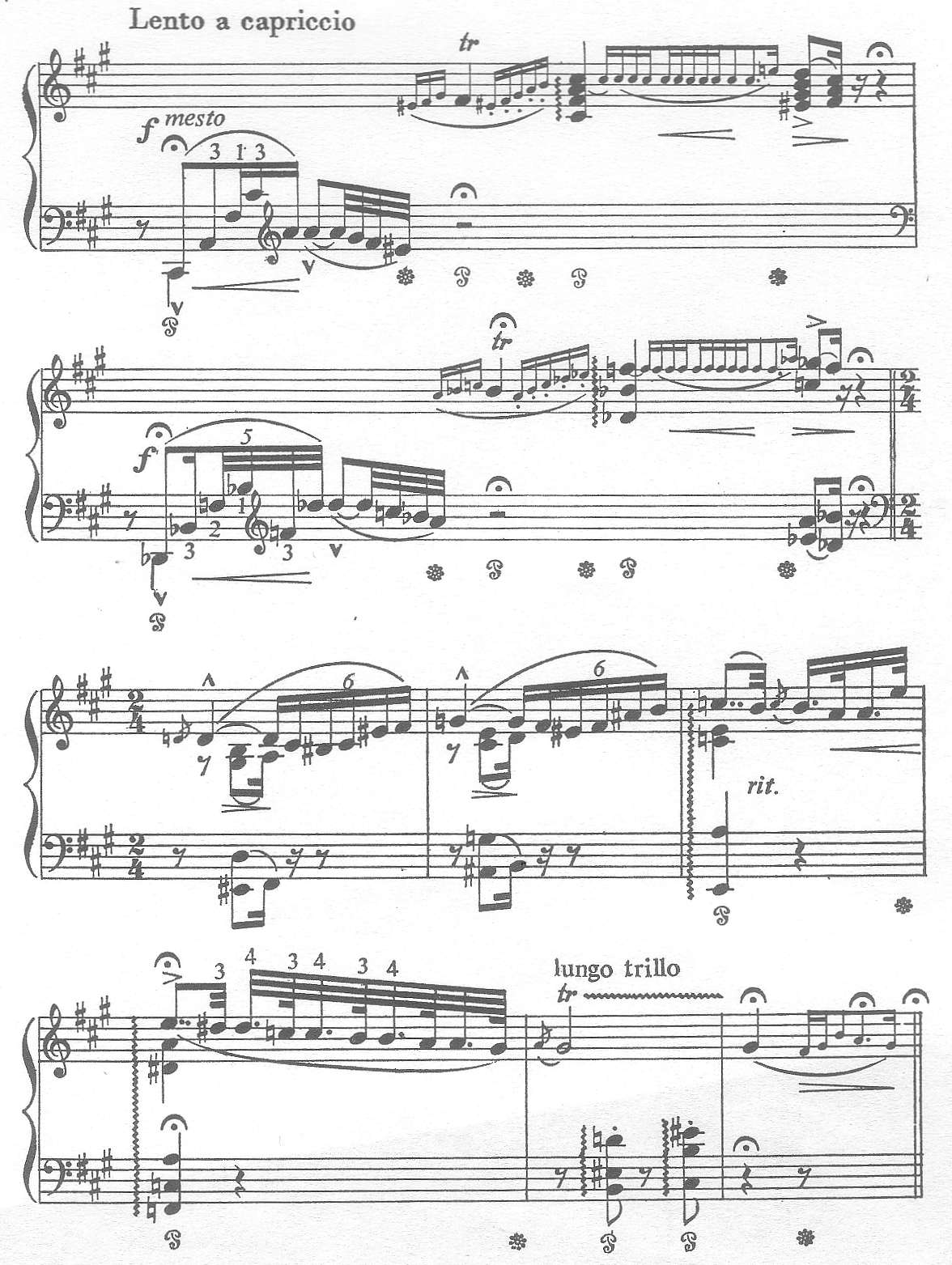
Sárosi demonstrates how Liszt adapted a well-known popular song (Ex. 1.3) for the first theme of his eighth Hungarian Rhapsody (Ex.1.4). In his composition Liszt imitated all the mannerisms of Gipsy performance, which he regarded as the true source of Hungarian music. The eighth rhapsody uses all the common musical clichés of Verbunkos performance: like: cimbalom-like broken chord ornamentation, fantasy-like breaking up of the vocal melody, emphasised dotted rhythms, grace-notes, trills and chromatic runs. Sárosi points out that “in the original melody there is no augmented second: here on the other hand there is.”20 In an attempt to notate the improvised practices of the Gipsy musician Liszt was less concerned with preserving the original character of the source material.
Ex. 1.3: Second theme from Rózsavölgyi’s Víg szeszély czardas: Káta tövén költ a ruca (In the rushes, that’s the duck’s home).21
Ex. 1.4: Extract from Liszt’s Hungarian Rhapsody, No. VIII.
Bartók’s nationalism
Bartók’s early nationalist views are well documented in his letters of 1902 and 1903 containing many references to his discontent at the prevalence of the German language, which was retained as the language of culture amongst the Budapest intelligentsia. Bartók imposed these views on his family by insisting on the use of the name “Böske” (the Hungarian diminutive for the German name Elizabeth), as a nickname for his sister, and requesting that Hungarian be spoken in their family home. It was also during this period that Bartók adopted the use of Hungarian national dress. In his essay “Autobiography” (1921), he described how he was caught up in the growing nationalist movement.
It was the time of a new national movement in Hungary, which also took hold of art and music. In music, too, the aim was set to create something specifically Hungarian. When this movement reached me, it drew my attention to studying Hungarian folk music, or, to be more exact, what at that time was considered Hungarian folk music.22
In his early youthful works, Bartók’s interest in nationalism was achieved by a synthesis of elements of the Hungarian music tradition with western Romantic influences. This was carried out in a manner that directly followed on from the Liszt precedent. These early musical works embraced the mythologized political function of the verbunkos tradition.
A good example is the tone poem Kossuth (1903), which celebrated the life of Lajos Kossuth, the leader of the abortive Hungarian revolution of 1848-49. The work was modelled on Strauss’s symphonic poem Thus Spake Zarathustra, which Bartók transcribed for piano in 1902. His overtly nationalist agenda was projected in both the thematic programme and musical material of the work.
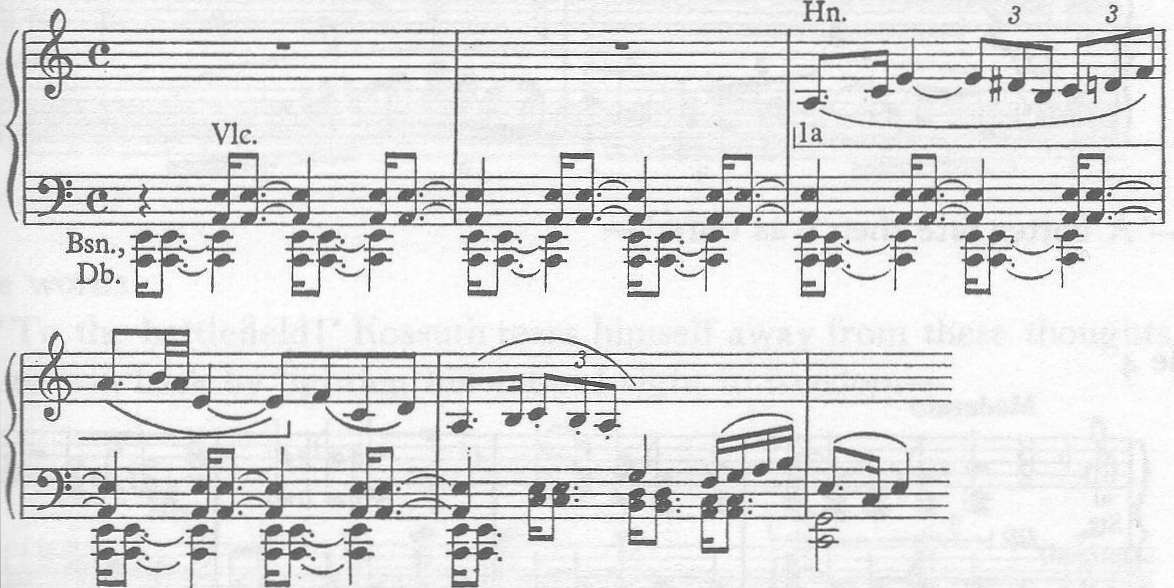
The opening theme is a sort of idée fixe, which delineates the character of the hero (Ex. 1.5), and contains a number of verbunkos influences.23 These include the characteristic dotted rhythm (long-short-long) with the use of an augmented fourth, which was the signifying feature of the gypsy scale (Ex. 1.6).
Ex. 1.5: Kossuth: the hero’s theme, bars 1-5.
Ex. 1.6: Gypsy scale with augmented intervals.

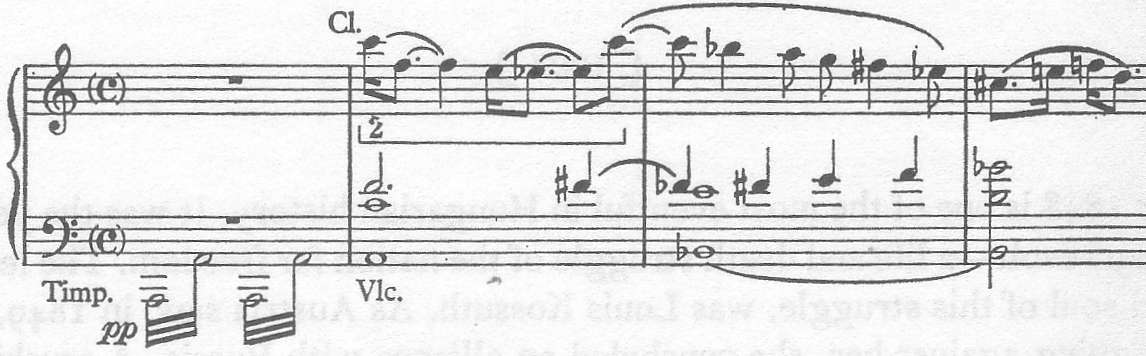
In the following section Bartók uses another rhythmical feature derived from verbunkos, the scotch snap (Ex. 1.7).
Ex. 1.7: Kossuth: thematic idea representing Kossuth’s wife, figure 3.
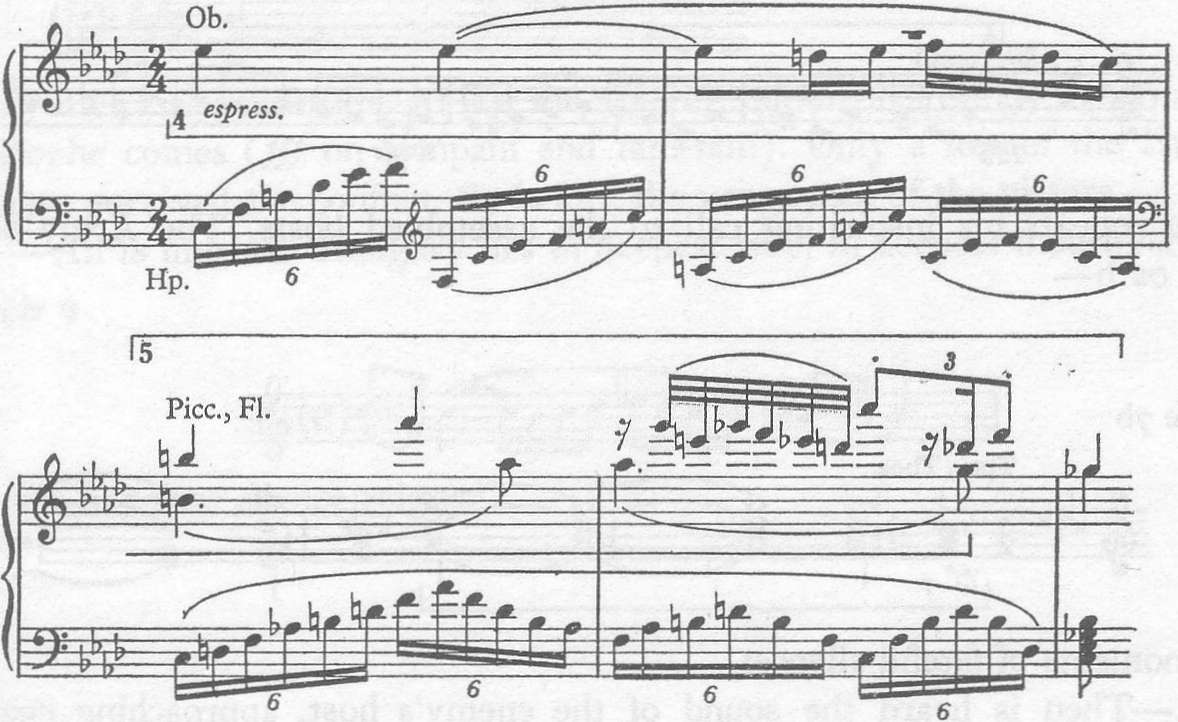
Another technique associated with the gypsy style of rendition was the florid ornamental line of the fifth section (Ex. 1.8).
Ex. 1.8: Kossuth: Section V.
In the two subsequent works: the Rhapsody Op.1 (1904), the Scherzo for Piano and Orchestra Op.2 (1904), Bartók continued to use verbunkos as the basic ingredient of his musical expression. This interest in nationalism was short-lived, and in the years 1904-1905, he became increasingly frustrated with the musical culture of Budapest. In a letter to Irmy Jurkovics of April 1905, he wrote:
The intelligentsia comes, almost exclusively, from foreign stock (as shown by the excessively large number of Hungarians with foreign names); and it is only amongst intellectuals that we find people capable of dealing with art in a higher sense. A real Hungarian music can originate only if there is a real Hungarian gentry. This is why the Budapest public is so absolutely hopeless. The place has attracted a haphazardly heterogeneous rootless group of Germans and Jews; they make up the majority of Budapest’s population.24
Bartók’s nationalist pronouncements should be understood as being entirely motivated by his frustration with the conventional forms of musical expression, and necessitated by his rejection of the German dominated tradition. Ferenc Glatz points out that Bartok was not a nationalist in an “ethnic” sense, but “was guided primarily by musical motives.”25 The discovery of a more authentic agrarian folk music led Bartók to completely re-evaluate his views on Hungarian music. Mary Gluck makes the point that this discovery liberated Bartók from not only “the stylised gypsy music of contemporary popular entertainment, but also from the forms and restrictions of nineteenth century classical music.26 Glatz goes on to write: “his program was to create a new type of music that would overthrow the centuries old dominance of German music, of German tunes and harmonies.”27
In the following chapter I will describe how Bartók furthered this objective by extensive ethnomusicological study into the true origins of Hungarian folk music. I will illustrate Bartók’s interest in the oldest examples of an indigenous folk music culture, which he considered a more natural mode of musical expression.
Chapter 2: The Discovery of Folk Music
The Discovery of Folk Music
The intention of this chapter is to illustrate how the dual activities of folk music collection and analysis occupied a major part of Bartók’s life. The discovery of rural folk music was an event that completely changed Bartók’s concept of Hungarian folk music tradition. In December 1904, while on holiday in the northern resort town of Gerlicepuszta (now Ratkó in Slovakia), Bartók heard the singing of Lidi Dósa, an eighteen-year-old nursemaid originally from the Székely province of Transylvania. She gave a rendition of the following folksong: 28
Ex. 2.1: Hungarian Folk song.
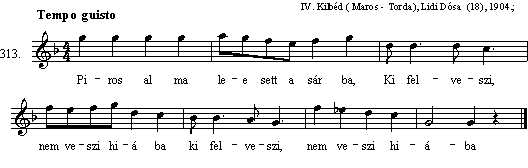
This song transforms the harmonic minor scale into an alternation of the Dorian and Aeolian folk modes (Ex. 2.2). As the pitches A and E are not placed on strongly accented beats, it can be shown that the melody has a pentatonic (G-B♭-C-D-F) substructure,
Ex. 2. 2: Hungarian Folk Music Scales
G-Dorian Folk Mode

G-Aeolian Folk Mode

Pentatonic Scale

Benjamin Suchoff draws our attention to the unusual structure of the melody, which deviates from the common four-line da capo (AABA) form, into a more unorthodox three-line (ABC) design.29 This modification of form and tonality was a revelation to Bartók. Halsey Stevens describes how: “this chance discovery brought to the young composer the realization that there was an autochthonous Magyar music of which he, like most of his compatriots, was entirely unaware.”30 In the words of Sándor Kovács: “it led to a change in his entire artistic outlook.”31
In the same year he wrote with enthusiasm to his sister Elza about a new project that was taking shape in his mind:
I have a plan now, to collect the finest examples of Hungarian folksong and to raise them to the level of works of art with the best possible piano accompaniment. Such a collection would serve the purpose of acquainting the outside world with Hungarian folk music. Our own good Hungarians…are much more satisfied with the usual gipsy slop.32
In his essay “Autobiography” (1921), Bartók described the project of collecting and classifying folk melodies, which led to a realization that the ideal musical expression was to be found in the peasant village, rather than the pseudo-folk tradition of the urban cultural centre:
In my studies of folk music I discovered that what we had known as Hungarian folk songs till then were more or less trivial songs by popular composers and did not contain much that was valuable. I felt an urge to go deeper into this question and set out in 1905 to collect and study peasant music unknown until then. 33
Béla Bartók using a phonograph to record Slovak folk songs sung by peasants in Zobordarázs
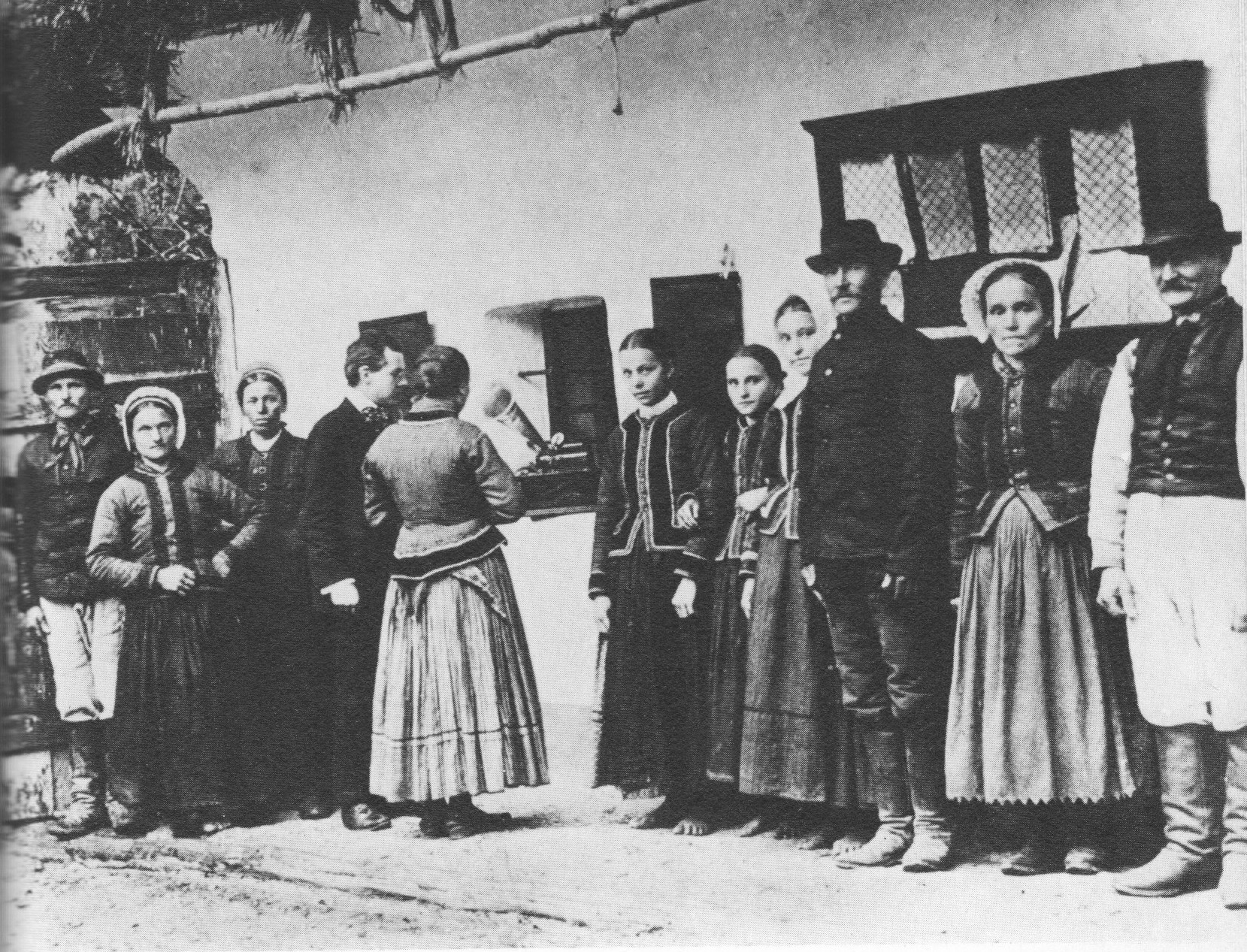
Bartók’s earliest impressions of folk music had consisted of the performance of songs by gypsy musicians. Kovács describes how: “the composer Bartók found the [urban] melodies less than inspiring while the patriot Bartók found himself obliged to cherish them.”34 In his essays Bartók continually stressed the fact that the melodies of popular song were not part of a homogenous folk tradition, but were the creations of individual composers from the urban middle classes. Bartók drew a very strong distinction between the “collective art” of the peasant and the contrived art of the urban culture:
The latter are composed mainly by dilettante musicians who have a certain musical culture generally imported from the city; therefore in the melodies of their invention, they blend certain Western commonplaces with certain exotic particularities of their own folk music. Consequently, even if these melodies preserve some faint exotic traces, they are too vulgar to have any intrinsic value. In contrast we find in the folk melodies properly so called, generally, a truly perfect purity of style. 35
In rejecting popular art-music, Bartók blamed Liszt for propagating a number of misconceptions about folk music. In his study Dés Bohémiens et de leur Musique en Hongrie, published in Paris in 1859, Liszt credited the gypsies with originating Hungarian music. He characterised the rural folk music tradition as being a perversion of Gipsy music. Bartók pointed out that this popular art-music was not the creation of the gypsies, nor was it part of a genuine Hungarian musical tradition.36
In his essay “What is Folk Music?” (1931) Bartók presented the following definition of peasant music:
The term peasant music, broadly speaking, connotes all the melodies which endure within the peasant class of any nation, in a more or less wide area and for a more or less long period, and which constitute a spontaneous expression of musical feeling of that class. 37
He made the observation that: “…folk music is not an individual art, that essentially it is a collective manifestation.”38 A style that “…connotes the totality of the peasant tunes exemplifying one or several more or less homogeneous styles.”39 In another essay “Hungarian Peasant Music” (1933) he made a further definition of this concept:
Peasant music, using the term comprehensively, is the complex of melodies which, in the peasant class – that is, in a class more or less removed from the culture of the town – now exist, or at any other period have existed, in whatever region or length of time, as a spontaneous gratification of the musical instinct or impulse. Or in a narrower sense, the complex of melodies so existing among the peasants and exhibiting a certain uniformity of style. 40
Bartok described how unfamiliar elements could penetrate the music of the peasant class, but they “… are transformed to the extent that they finally appear to be homogenous in musical structure and other features, and they are very divergent from the infiltrated original.”41
It is obvious, indeed, that no essential alteration of a musical element can come from one individual peasant. And there can be no doubt that with peasants who people one geographical unit, living close to one another and speaking the same language, this tendency to alter, in consequence of the affinities between mental disposition of individuals, works in one way, in the same general direction. It is thus that the birth of a homogeneous musical style becomes possible. 42
Stevens points out that Bartók discovered two opposite tendencies in peasant music: “the first to preserve their old traditions and customs without change and the second to imitate at least the external signs of upper-class culture.”43 If the imitative tendency becomes greater than a conservative instinct the music is varied and transformed. Bartók claims that this aspect was not so much a result of the invention of peasants, but “…the outcome of changes wrought by a natural force whose operation is unconscious in men who are not influenced by urban culture.”44
Bence Szalbolcsi illustrates this association between peasant music and the forces of nature with a quote from Bartók’s writings of 1931:
We profess ourselves to be scientists who have chosen as the subject of their study a certain product of nature, peasant music.45
Bartók considered folk culture as being an equal to the organic natural life of the countryside, and like many other aspects of the natural landscape, it could be subject to careful research and analysis.
Fieldwork
In 1905 Bartók secured a grant to collect folk songs in the remote villages of Transylvania. His priority was to collect in areas near the periphery of the country where he felt society was less influenced by urban culture and in this way discover more evidence of an ancient musical culture.
The following year Bartók was introduced to a composition student, Zoltán Kodály, also a student at the Academy of Music, Budapest. They had not attended the same classes and were previously unknown to each other, but they quickly became friends. At the time of their meeting Kodály was in the process of finishing a doctoral dissertation on the stanzaic structure of Hungarian folksong (A Magyar népdal strófaszerkezete, 1905). Their contact was to prove extremely productive to Bartók’s interest in folk music research. Kodály introduced him to one of the most important ethnographic techniques, the Edison phonograph. Béla Vikár pioneered the use of this recording technique as a means of preserving folksong, and during the years 1896-1910 he recorded 1500 examples of Hungarian peasant music. The phonograph method, used by both Bartók and Kodály, was a very important method of collecting material in the field. By recording melodies on wax cylinders, Bartok was able to capture every nuance of performance, which he could study later at his own convenience. Stevens points out that Bartók’s work sheets of this period, demonstrate the meticulous accuracy with which he applied himself to the process of transcription:

The original notation is in black ink with numerous corrections and variants overwritten in green, modifications in pitch and every fluctuation in rhythm of ornamentation painstakingly indicated.46
The initial contact with Kodály led to a collaborative project in 1906 that set out primarily to raise the awareness of the Hungarian public to their true folk music heritage. Together they worked as a team and divided the fieldwork, with Kodály going north to Nyitra county and Bartók going south to Békés. The result was the publication of Magyar népdalok (Hungarian Folksongs) in 1906 (twenty folksongs arranged for voice and piano by Bartók and Kodály). In the preface to this volume they outlined a dual function of the collection to create “a comprehensive dictionary of folksongs,” and to introduce folk music in “a form that is more palatable to the taste of the public.”47 Magyar népdalok was the first of many volumes that Bartok produced, which incorporated folksongs with his own individual musical expression.
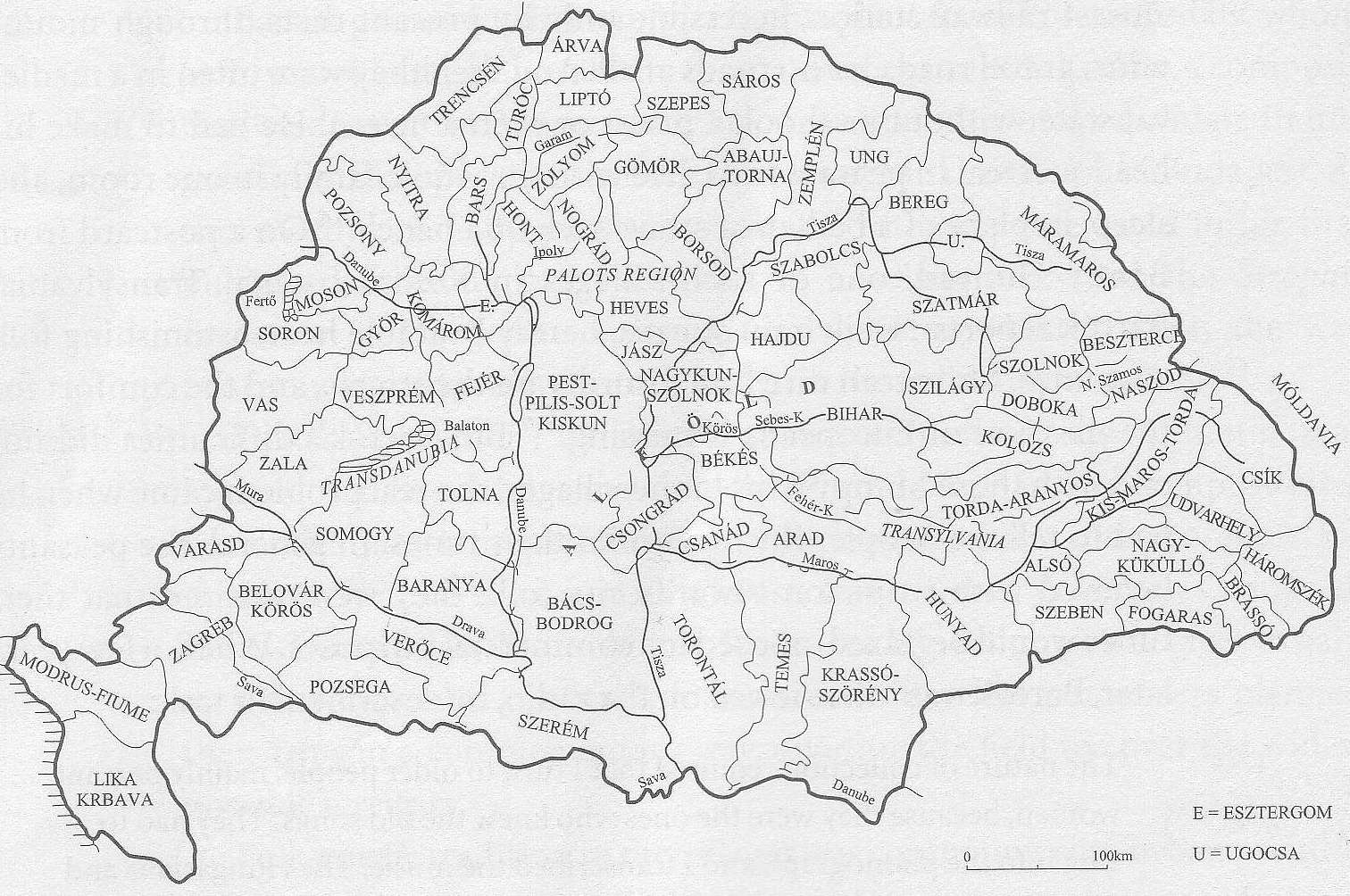
In the summer of 1907 Bartok was finally able to use his grant to travel to the Székely country of Transylvania, visiting the districts of Csík, Gyergyó and Kolozs (See map in Ex. 2.348).
Ex. 2.3: Counties of Hungary before 1919 and dialect areas
Bartók faced many difficulties during field trips to remote areas, as they were often far away from modes of transport like the railway and were often difficult to access even by road.49 In a letter to his mother, he described some of the primitive conditions he witnessed in a village in the Kolozs county: “in the streets of Bánffy-Hunyad the filth and litter is quite Moroccan without any of the amenities imported there for the sake of the Europeans.”50
Getting the locals to sing was a feat of persuasion. Bartók illustrated this in his essay “The Folk Songs of Hungary (1928):51
It would probably be difficult for you to imagine the great amount of toil and labour connected with our work of collection. In order to secure musical material uninfluenced by urban culture, we had to travel to villages as far as possible removed from urban centres and lines of communication. There were many villages as that time in Hungary. In order to obtain older songs – songs perhaps centuries old – we had to turn to old people, old women in particular, whom, quite naturally, it was difficult to get to sing. They are ashamed to sing before a strange gentleman; they were afraid of being laughed at and mocked by the villagers; and they were also afraid of the phonograph (with which we did most of our work), as they had never in their life seen such a ‘monster’. We had to live in the most wretched villages, under the most primitive conditions, as it were and to make friends of the peasants and win their confidence. And this last, in particular, was not always easy, for in previous times the peasant class had been too thoroughly exploited by the gentry, and, in consequence, was full of suspicion where those who appeared to belong to this class were concerned. Yet despite all this, I must admit that our arduous labour in this field gave us greater pleasure than any other. Those days which I spent in villages among the peasants were the happiest days of my life.
The discovery of a surviving repertoire of pentatonic tunes was the most significant finding of the 1907 field trip. He referred to them in a letter to his pupil Etelka Freund:
I have made a rather strange discovery while collecting folksongs. I have found examples of Székely tunes which I had believed lost.52
Kodály described Bartók’s return from his 1907 field trip:
He came back with such a pile of pentatonic melodies that, in conjunction with my own simultaneous findings in the north, the fundamental importance of this hitherto unnoticed scale suddenly became obvious.53
Stephen Erdely points out that this was “Bartok’s first proofs of the survival of an ancient musical tradition.”54 It was in the Székely country in the far east of old Hungary, now beyond the boundaries of Hungary set by the Treaty of Trianon, 1920, that the best-preserved examples of this ancient tradition were to be found. Bartók attributed this fact to the geographical isolation from the rest of Hungary and the inadequate means of communication with other Hungarian speaking areas.55
Bartók stressed the importance of an ethnographic approach to the music of neighbouring peoples. Benjamin Suchoff describes Bartók’s interest in the mutual musical influences of minorities in the pre-Trianon Hungary:
He not only unearthed ancient pentatonic melodies still in vogue but also discovered completely different genres as well as Hungarian influences in the music of neighbouring villages inhabited by Romanians. He therefore decided that he would further extend his research to the folk music of the Transylvanian Romanians, in order to determine the nature and extent of reciprocity between Hungarian peasant music and minorities of people living in greater Hungary.56
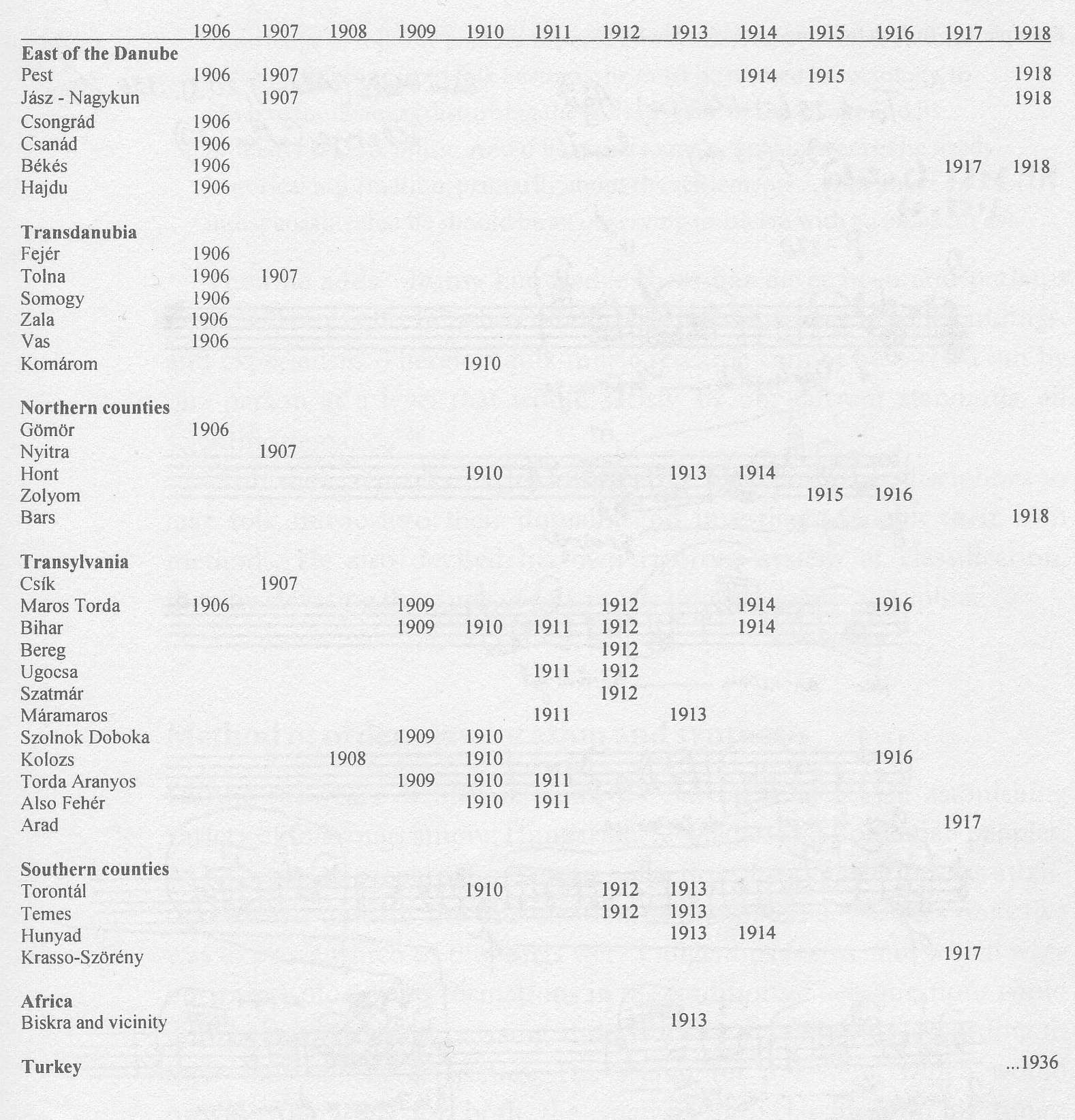
In subsequent field trips, in addition to collecting his native Hungarian folksong, Bartók collected material from both the Rumanian and Slovak minorities (See Ex. 2.457 for details of Bartók’s field work from 1909-1918).
After his 1907 appointment as Professor of Piano at the Academy of Music in Budapest, Bartók mainly confined his fieldwork to holidays and summer months. He visited Slovakian villages every year from 1906 and engaged in a comparative study of the music of the Hungarian and Slovak peoples. In 1912 he collected Ruthenian melodies, and in the same year, collecting in the Bánát area yielded Serbian and Bulgarian material.
Ex. 2.4: List of counties Bartók visited in different regions, with dates.
In the summer of 1909 and in subsequent years Bartók collected folk songs from the Romanian minorities in Transylvania. He describes isolated villages with illiterate inhabitants: “when one comes into such a region, one has the feeling of a return to the middle ages.”58
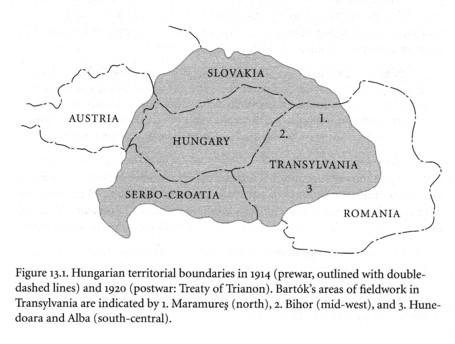
Bartók’s fieldwork in Romania was concentrated in the provinces: Maramureş (north), Bihor (mid west) and Hunedoara (Ex. 2.559).
Ex. 2.5: Hungarian territorial boundaries in 1914 (pre-war outlined with double dashed lines) and 1920 (post-war: Treaty of Trianon). Bartok’s areas of fieldwork in Transylvania are indicated by: 1. Maramureş (north), 2 Bihor (mid-west) and 3 Hunedoara and Alba (south-central).
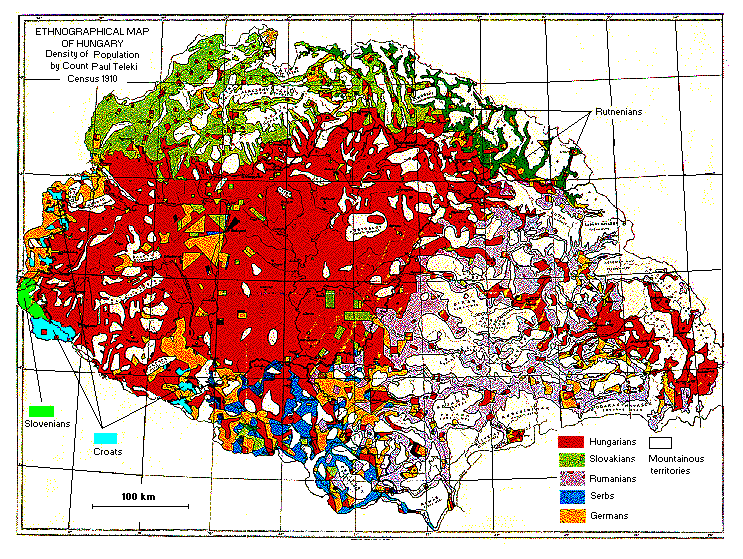
These activities continued until his research was disrupted by the outbreak of World War I in 1914 and the subsequent division of Hungarian territory set out in the Trianon treaty. Bartók was especially attracted to the Transylvanian region because of its ethnic diversity (Ex. 2.6), but as a result of partition, the specific territory that Bartók was most interested in was ceded to Romania and the resulting political situation prevented him from entering these areas again.
Ex. 2.6: Ethnographical Map of Hungary (1910)
Bartók was concerned with finding the ancient origins of Hungarian music, which was a task that also required the examination of other folk music cultures. This led him to consider the influence of Persian-Arab music on the folk music of Eastern Europe. In 1912 Bartók visited the Maramureş region and discovered an unusual style of vocal elaboration called the horă lungă (see Ex. 5.9). The following year he travelled to Biskra in Algeria, where he found a very similar type of vocal rendition.60 This prompted him to adopt a pan-national, comparative approach to his continuing ethnomusicological work. In 1931 he wrote:
One could and should disclose the ancient cultural connections of peoples who are now far from each other; one could clarify problems of settlement, history; one could point to the form of contact, to the relationship or contrast of spiritual complexion of neighbouring nations. 61
Classification
Stephen Erdely states that by the end of World War I, both Bartók and Kodály had together accumulated in the region of 8000 Hungarian folk melodies.62 Bartók’s fieldwork alone comprised a further 3200 Slovakian melodies, 3,500 Romanian melodies, 200 Ruthenian, South Slavic and Bulgarian tunes, and 69 Arabian melodies.
After his fieldwork activities ceased in 1918, Bartók’s folksong work entered a more analytical phase as he began the vast task of classifying collected material. His first significant publication of folk song transcriptions, Cântece poporale romaneşti din comitatul Bihor [The Romanian Folksongs from Bihor Country], was published in 1913 by the Romanian Academy in Bucharest. The work contained 371 melodies, an introduction, texts and notes. Bartok grouped the tunes, not according to genre but adopting a system of classification from the work of the Finnish collector Ilmari Krohn (1886-1960). According to this system there are four considerations: the number of lines, the pitch of the final note of each line, the number of syllables in each line, and the range of the melody. In the Krohn system each tune is transposed so they all have a common tonus finalis on the pitch G.
In his first major publication of Hungarian folksong, A Magyar Népdal [The Hungarian Folk Song] in 1924, Bartók classified material according to the Krohn system. Instead of grouping music according to its functioning role, Bartók established three basic stylistic divisions:
A- Old style
B- New Syle
C- Mixed Style
Kovács points out that the melodies of the “old style” are subdivided in a way that is primarily intended to show evolution of material.63 Melodies from the “old style” are characterised by their free declamatory rhythm (parlando rubato), which is adapted to the word inflections of the Hungarian language. The oldest songs have four isometric text-lines, which consist of twelve-, eight-, or six-syllables. Their main characteristic features are the non-architectural structures (ABCD and ABBC) and the Hungarian pentatonic scale (Ex. 2.7).
Ex. 2.7: Old Style Pentatonic Folk song with twelve syllables lines (ABBC).
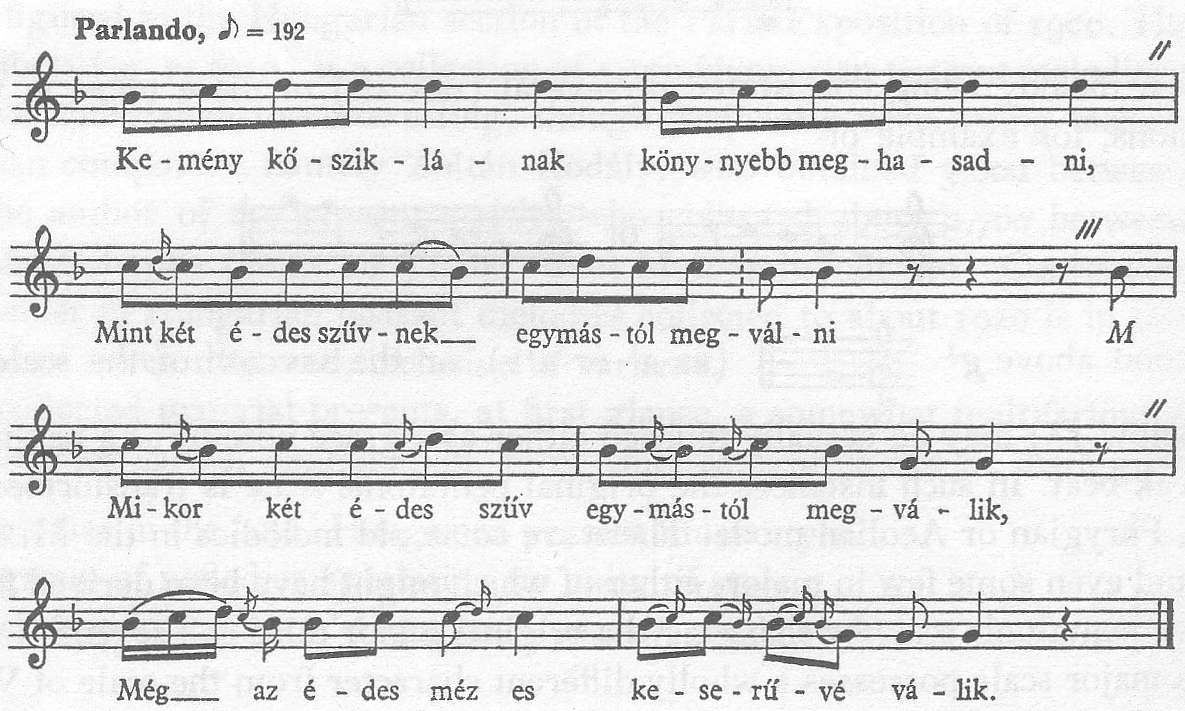
The first main caesura (end of second line), the mid point cadence, falls most often on the flattened third. In some cases the pentatonic structure of melodies is transformed into Aeolian, Dorian and Phrygian folk modes (Ex. 2.8).
Ex. 2.8: Old Style Folk Song, Dorian Mode, 8 Syllable lines, (ABBC).
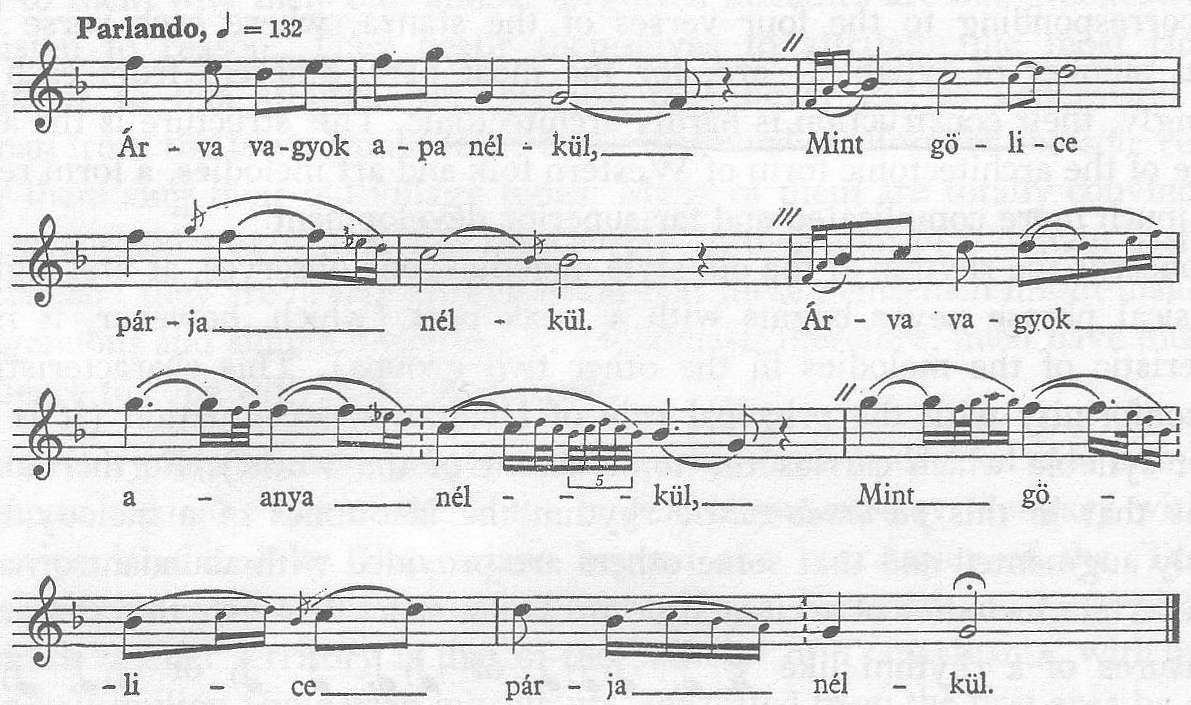
Bartók describes the “old style” melodies as being specific Hungarian cultural products because of their radical divergence from the melody types of neighbouring countries. This discovery lent itself to the hypothesis that “old style” melodies were remnants of ancient Asiatic musical culture.64
Unfortunately we have no direct proof of their age; but one can draw the conclusion of old age from their antique mode of ornamentation, primitive pentatonic scale, antique character of underlying texts and so forth. 65
Bartók stated that the “old style” melodies presented “the most interesting, exciting, and valuable features,” and it can be shown that these aspects exerted a significant influence on his music. 66
In contrast the “new style” melodies had a greater inclination towards Western influences like architectonic form (AABA), major scales and mid-point cadence on the fifth or tonic (Ex. 2.9).
Ex. 2.9: New Style Melody, Major Scale, Architectonic form (AABA).
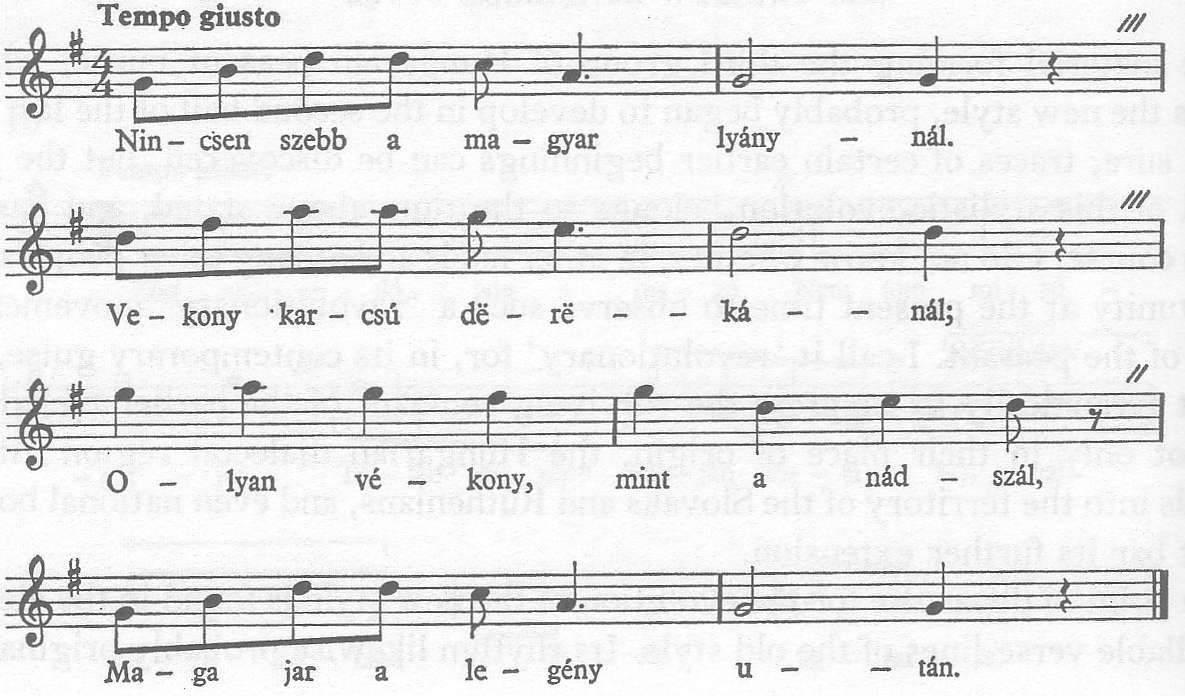
A significant feature of these tunes is invariable rhythm (tempo guisto) with heterorhythmic melodic lines. Bartók pointed out that many of them still preserved the characteristic pentatonic phrases of the “old style”, some being in the Dorian, Mixolydian or Aeolian modes. They demonstrated a much greater cross fertilisation with the folk music of neighbouring counties than had occurred before.
The “mixed style” melodies were least interesting to Bartók, who claimed that they were of a heterogeneous type, demonstrating the infiltration of Western European musical culture.
Bartók’s ethnomusicological work continued throughout his entire life and in the 1920s he did extensive work on two important Slovakian and Romanian collections, both of which were not published during his lifetime. His work on Hungarian folk music continued at the Hungarian Academy of Sciences from 1934 to 1940 and was aimed at the preparation of Corpus musicae popularis hungaricae. This was another project, which was never published during Bartók’s lifetime. The final chapter of Bartók ethnomusicological research occurred during his American years, when he transcribed recordings held at Columbia University of South Slavic melodies made by Milman Parry in the mid-1930s.
In the following chapter I will discuss Bartók’s use of folk melody in the art-music genre. This will be achieved with analysis of Bartók’s folk music settings, the majority of which he published during the early phase of his composing career.
Chapter 3: The Mounting of a Jewel
The Mounting of a Jewel.
The number of Bartók’s folk music arrangements is estimated at nearly two hundred by Victoria Fischer, the majority of which were settings for solo piano.67 This activity, which spanned Bartók’s entire career, was most concentrated during the period 1906-1918, occurring when Bartók undertook the vast majority of his fieldwork.
In a lecture given at Columbia University, Bartók described the arranging of folk melodies as the “mounting of a jewel.”68 This was the first of three different categories of folk arrangement outlined by him in 1931.
(1) The folk melody is the most important part of the work and the accompaniment takes second place.
(2) Equal importance of accompaniment and melody.
(3) Added compositional treatment is the most important part and the melody is “only regarded as a kind of motto.”69
This three-level concept of folk music arrangement demonstrated the evolution of Bartók’s concepts for the assimilation of folk material into art-music..
The entry of folk song into Bartók’s musical vocabulary was an outcome of his meticulous transcription work, and consequently we can view Bartók’s ethnomusicological activities as part of his overall compositional training. In this chapter, by looking at Bartok’s early folk music settings, I will illustrate what Paul Griffiths calls the marriage of Bartók’s creative and ethnomusicological self.70 It will show how Bartók’s extensive analysis of transcriptions influenced his musical thinking. Examples of Bartók’s harmonisations of folk music arrangements will illustrate the derivation of harmonic structures from modal properties.
Derivation of Harmonic Structures
In his essay “Autobiography” (1921), Bartók talked about the considerable influence that folk music studies had over his harmonic thinking:
The outcome of these studies was of decisive influence upon my work, because it freed me from the tyrannical rule of major and minor keys… It became clear to me that the old modes, which had been forgotten in our music, had lost nothing of their vigour. Their new employment made new rhythmic combinations possible. This new way of using the diatonic scale brought freedom from the rigid use of major and minor keys, and eventually led to a new conception of the chromatic scale, every tone of which came to be considered of equal value and could be used freely and independently.71
Bartók drew attention to the fact that most Western European musicians “believed that only simple harmonisations were well suited to folk melodies.”72 This was usually achieved by a succession of tonic, dominant and subdominant triads. Bartók argued that the fundamental difference between Eastern European and Western European folk music was that it “generally avoids allusions to the dominant triad in its melodic structure” and in this way avoids conventional cadence structures.73 In his lecture recital “The Folksongs of Hungary” (1928), he pointed out that the old modes (Dorian, Phrygian, Mixolydian, and Aeolian), which are found in abundance in Hungarian folk music, generally lack a dominant harmonic function for the fifth degree (Ex. 3.1).
Ex. 3.1: Heptatonic Folk Modes
G-Dorian

G-Phrygian

G-Mixolydian

G-Aeolian

In the absence of the leading note, major seventh (F♯) the conventional dominant/tonic resolution (Ex. 3.2) does not occur.
Ex. 3.2: Perfect Cadence
Bartók pointed out that the Hungarian pentatonic scale functions in a similar way: “since the second degree [A] and major seventh [F♯] are missing, the trite dominant-tonic cadence is not possible”74 (Ex. 3.3).
Ex. 3.3: Pentatonic scale (the missing 2nd and 6th diatonic degrees are marked with arrows).

Bartók was primarily interested in the symmetrical relationship of the third, fifth and seventh degrees of the pentatonic scale, a circumstance, which he says exerted an important influence on his harmonic thinking.75 In Bartók’s work the minor-seventh-chord, constructed from these degrees, adopts a consonant character and is frequently used at points of rest – even final cadences.

A Closer Look
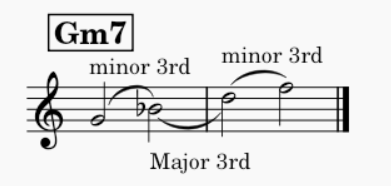
The minor seventh chord has an internal symmetry: a minor third, a major third, and a minor third. Bartók could end a phrase or a whole piece on it without it feeling unfinished, since nothing in its own internal shape is pulling it anywhere else. There is no leading note that needs resolution.
Bartók derived new and interesting harmonic materials from the pentatonic scale, but did not limit himself to its triadic resources. It can be shown that, apart from the minor-seventh-chord, the pentatonic scale contains only two other triads and their inversions. In his arrangements Bartók frequently employed non-diatonic notes and chords that supported melody notes, but which did not form part of them.
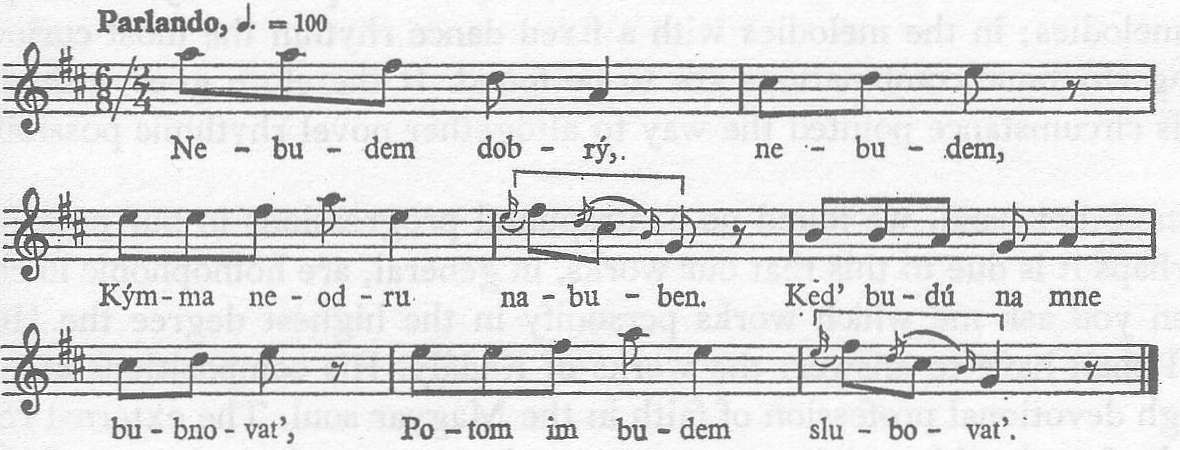
Another harmonic idea Bartók derived from folk music was the important role of the interval of a tritone. He attributed this to its use in Romanian and Slovakian folk music in the Lydian mode (Ex. 3.4).
Ex. 3.4: Folk Song in the Lydian Mode.
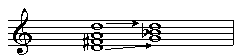
In his lecture series “The Folk Songs of Hungary” Bartók pointed out that these melodies brought about the free use of the tritone and chords (Ex. 3.5).
Ex. 3.5: Chords using the interval of a diminished fifth.
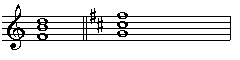
Through inversion, and placing these chords in juxtaposition one above the other, many different chords are obtained and with them the freest melodic as well as harmonic treatment of the twelve tones of our present day harmonic system,76
One of the most important concepts in Bartók’s harmonic thinking was the idea of bi-modality or polymodality. Bartók juxtaposes different pitch collections, based on a common pitch, to derive extensions from the basic diatonic mode. In his 1945 Harvard lectures Bartók outlined the use of a Phrygian/Lydian combination to create a twelve-note polymode of the chromatic scale (Ex. 3.6).77 In this way he was able to use homophonic pitch relations to expand his harmonic palette to all twelve tones of the chromatic spectrum.
Ex. 3.6: Combination of two heptatonic modes to create a twelve-note chromatic scale.

Bartok maintained that these chromatic degrees should not be considered as altered chord degrees, but should be understood as “diatonic ingredients of a diatonic scale.”78 He went on to say in his Harvard lectures.
Bi-modality led towards the use of diatonic scales or scale portions filled out with chromaticised degrees which have a totally new function. They are not altered degrees of a certain chord leading to a degree of a following chord. They can only be interpreted as the ingredients of the various modes used simultaneously and at a given time, a certain number of seemingly chromaticised degrees belonging to one mode, other degrees to another mode. These degrees have absolutely no chordal function; on the contrary, they have a diatonic-melodic function.79
Bartók called this technique “modal chromaticism,” which he distinguished from the “chordal chromaticism” of the late nineteenth century.
Vocal Arrangements
Bartok’s first vocal arrangements was a volume of twenty songs published in collaboration with Kodály. This volume, Magyar népdalok (1906), contains what Bartók and Kodály called “choice pieces” that set out to popularise the art of the folk song and make it more accessible to the public. In the preface, the composers stated their intention to cut new clothes for the melodies “so as not to cramp their fresh country style.”80 This reserve is achieved with unobtrusive, level one-type, accompaniments, which simply double the vocal line. Vera Lampert describes how the content of this collection reflects modal and rhythmic characteristics of folk music:
There are several traces of the archaic pentatonic scale (lacking any half steps) as well as Dorian, Mixolydian and Aeolian melodies. Yet the harmonisations follow traditional paths, especially in the fast songs. The harmonisation of the slow songs show more affinities to the particular features of the melodies, although they are extremely reserved.81
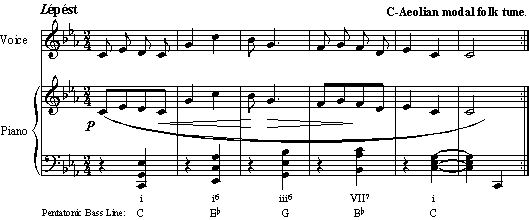
The sixth song, a “new style” C-Aeolian folk melody, is fairly conventional in its method of harmonic accompaniment, as it uses a system of chordal chromaticism. It does, however, demonstrate tendencies that are characteristic of Bartók’s later arrangements. The accompaniment avoids conventional harmonic movement by punctuating the tune on the offbeat. The influence of pentatonicism is apparent, as there is no cadential leading-note movement to C. The left hand accompaniment of the first section (bars 1-6), with the exception of the A in bar 4, is comprised of the notes C, E𝄭, G & B𝄭 from the C-pentatonic collection (C, E𝄭, F, G & B𝄭) (Ex. 3.7). This illustrates the relationship of the Aeolian mode to an underlying pentatonic substructure. Elliot Antokoletz points out that these modalities show a weakening of traditional dominant-tonic relations.82
Ex. 3.7: Twenty Hungarian Folksongs, No. 6, bars 1-6.
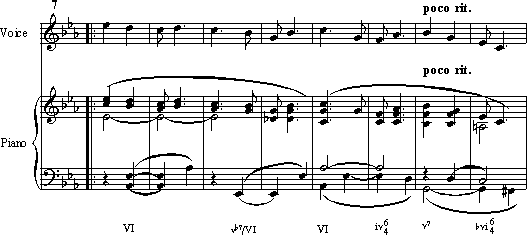
In the second section of the tune Bartók enriches his harmony language with chromatic inflections (D𝄭, A, F♯ and E), which are not a feature of the C-Aeolian melody. These pitches belong to the tonal progressions, supporting the melody, but are not a part of the modal structure.
Ex. 3.7: Twenty Hungarian Folksongs, No. 6, bars 7-14.
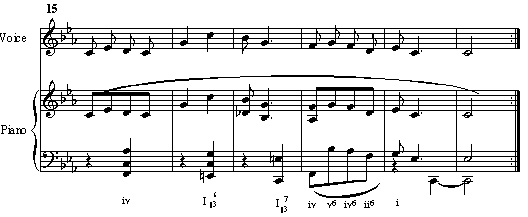
An interesting aspect of the C-Aeolian folk tune is the lack of a melodic (as well as harmonic) structure to support conventional progressions, such as a V-I progression. The final cadence in bars 18 & 19 avoids the leading note, illustrating the lack of dominant-tonic relations of the Aeolian mode. Bartók’s method of handling tonal progressions is faithful to the modal harmonic language of the original folk melodies.
Ex. 3.7: Twenty Hungarian Folksongs, No. 6, bars 15-20.
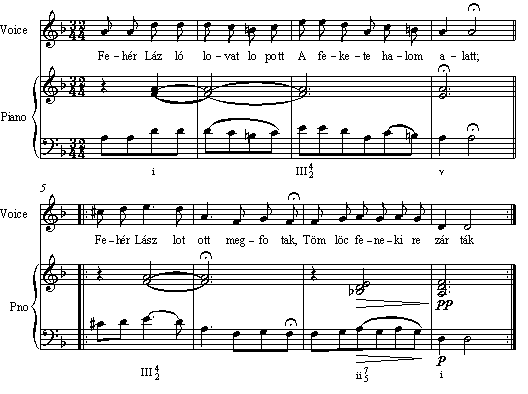
A good example of the use of an “old style” (parlando rubato) tune is found in No. 3a (Ex. 3.8). Bartók hangs a D-Dorian melody on a simple sequence of sustained two or three parts chords, contrasted with a stepwise moving line.
In the second half of the song, the B𝄭 (bar 7) can be described as a passing chordal inflection. It is debatable whether Bartók thought of this note as a chordal or modal chromaticism. A bi-modal analysis would suggest that the B𝄭 emphasises the D-Aeolian collection (D, E, F G A B𝄭 & C). This is supported by the D-Pentatonic collection (D, F, G, A & C), a subset of D-Aeolian, which is emphasised by the final three bars of the melodic line.
The Dorian and Aeolian modal scales relate to a basic pentatonic substructure. The following table illustrates the symmetrical, pentatonic core linking modal collections.
D-Pentatonic Mode | D | F | G | A | C | ||||
D-Aeolian Mode | D | E | F | C | A | B𝄭 | C | ||
D-Dorian Mode | D | E | F | C | A | B | F | ||
D-Phrygian Mode | D | E𝄭 | C | A | B𝄭 | F |
Ex. 3.8: Twenty Hungarian Folksongs, No. 3a.
In 1907 Bartók arranged five songs, from the Csík district of Transylvania. This cycle was completed in 1917 and published in 1922 as Nyolc Magyar népdal [Eight Hungarian Folksongs]. Paul Griffiths points out that this collection differs from the enterprise of the previous year, as the piano enjoys a more extended role and “is not an anxious shadow of the voice but a compliment to it.”83 The inspiration for the collection came from Bartók’s trip to Transylvania and his subsequent discovery of a large body of pentatonic songs. Vera Lampart describes Bartók’s preoccupation with the pentatonic scale:
The first five of these Eight Hungarian Folksongs, at least, represent the immediate creative reaction to the discovery of ancient pentatonic melodies.84
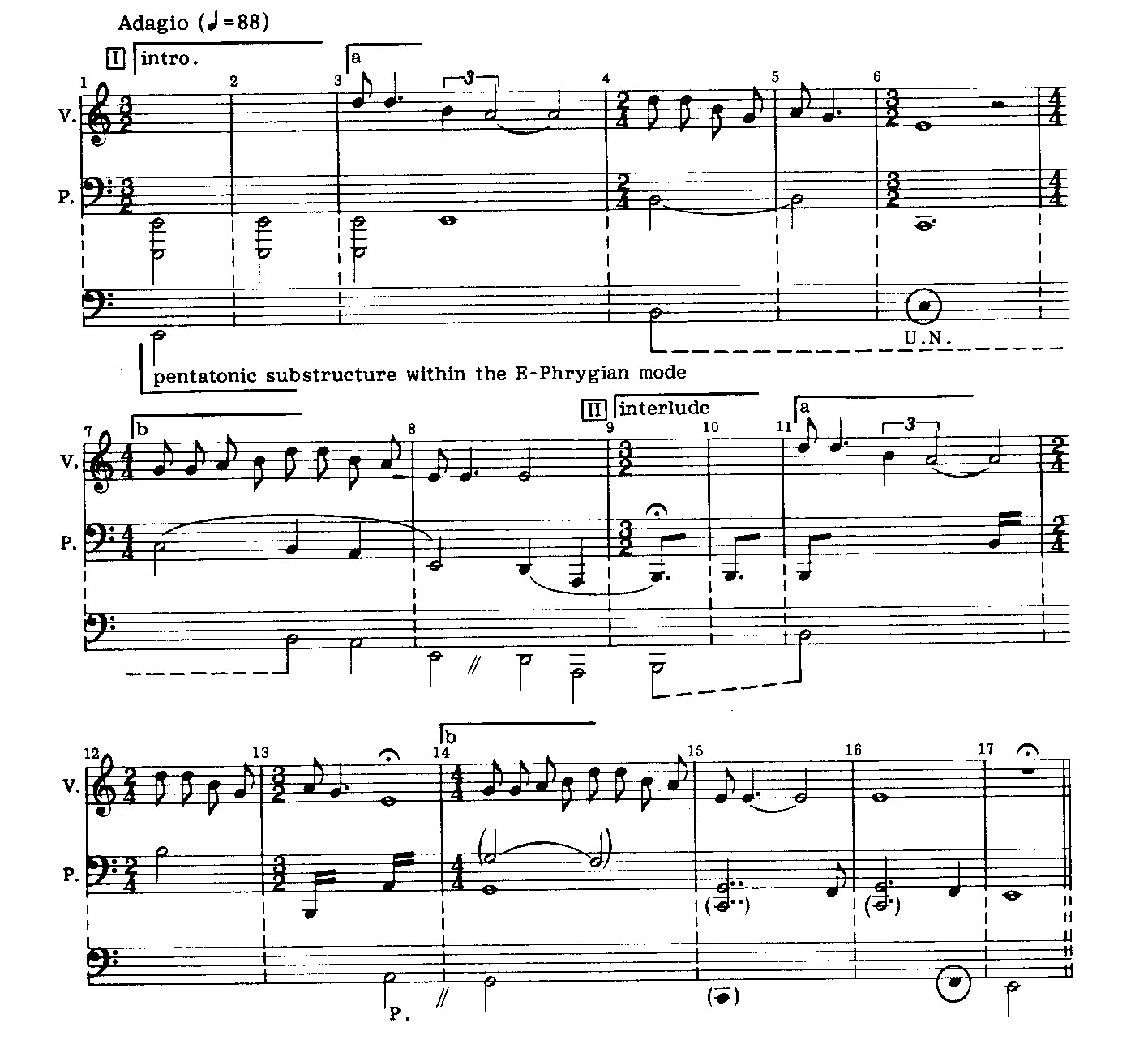
Elliot Antokoletz has demonstrated how Bartók harmonises the pentatonic melody using segments from different modal collections.85 The first song, “Black is the Earth,” has a E-pentatonic vocal line and a Phrygian substructure. Antokoletz shows the projection of the pentatonic line into the bass line where it forms a complete statement of the E-Phrygian mode (Ex. 3.9).86 The tonal priority of E is preserved by the contrapuntal alignment of E-Phrygian against E pentatonic.
Ex. 3.9: Antokoletz’s analysis of Eight Hungarian Folksongs, No. 1.
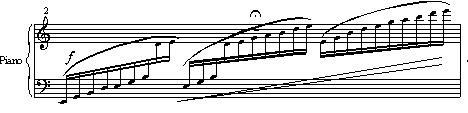
In the opening two bars, at the point where the voice enters, the piano sets the mood by alternating between the minor seventh chord (E, G, B & D) and the full pentatonic collection (E, G, A, B & D) (Ex. 3.10).
Ex. 3.10: Eight Hungarian Folksongs, no. 1, bar 2.
The C♯ of bar 3 is the first major deviation from the notes of the pentatonic scale. Antokoletz points out that the C♯ and the F♯ belong to the E-Dorian pitch collection (E, F♯, G, A, B, C♯ & D).87 The cadence (bar 5) introduces the notes F and C, which belong to the E-Phrygian pitch collection. This altering of the second and sixth degrees allows the music to traverse different modes linked by their common pentatonic pitches.
Ex. 3.10: Eight Hungarian Folksongs, No. 1, bars 3-8.
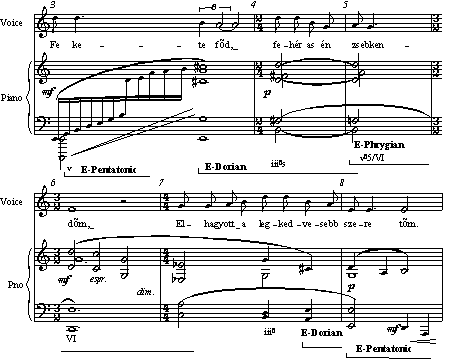
Bartók identified a type of pentatonic scale in Hungarian music “in which the second and sixth degree of the diatonic scale occur, but as secondary, ornamental notes only.”88 This variability of the second and sixth degrees provides a way to enrich the tonal palette and also retain a firm point of reference. Antokoletz points out that the significance of the E-Dorian and E-Phrygian collections is that together they “symmetrically expand around the common E-Pentatonic nucleus.”89
E-Dorian Mode | E | F♯ | G | A | B | C♯ | F | ||
E-Pentatonic Mode | E | G | A | B | |||||
E-Phrygian Mode | E | F | G | A | B | C | F |
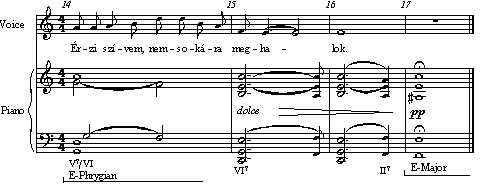
In the middle section Bartók returns to arpeggiated figuration harmonised by the pentatonic scale. The final phrase is harmonised in E-Phrygian with a modally weakened VI7-II7-I cadence.
Ex. 3.10: Eight Hungarian Folksongs, No. 1, bars 14-17
The third song (“Wives let me be one of your company”) also demonstrates Bartók’s early treatment of modal harmony. Antokoletz points out that this song is the first one of the set that is not entirely pentatonic and is quite modally ambiguous, implying both E𝄭-Aeolian and E𝄭-Phrygian modality.90 Bartók arranged the three-verse song with a through-composed accompaniment rather than conventional strophic treatment. In the first verse he uses the bi-modal technique of chromatic filling of a basic common pentatonic structure. In the second verse, bars 13 – 17, a greater level of extension to the modal structure is employed, as contrasting statements of E-Major and E-Minor chords conflict with the E𝄭-Phrygian collection (Ex. 3.11).
Ex. 3. 11: Eight Hungarian Folksongs, No. 3, bars 13-17.
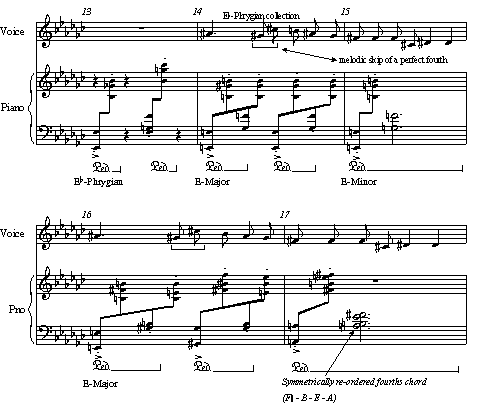
The final chord of this phrase illustrates Bartók’s interest in using symmetrical pitch constructions as consonant structures. This chord is derived from the melodic use of the perfect fourth interval in folk melody. He writes:
The frequent repetition of this remarkable skip occasioned the construction of the simplest fourths chord (which was filled in to be completed as a consonant chord) and its inversions.”91
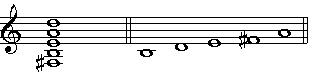
At the end of the second line, bar 17, Bartók uses a re-ordered, symmetrical fourths chord (A, B, E & F♯) in a consonance cadential function. These chords can be seen as a re-ordering of the notes of the pentatonic scale.
Ex. 3.12: Fourths Chord and B-Pentatonic Collection
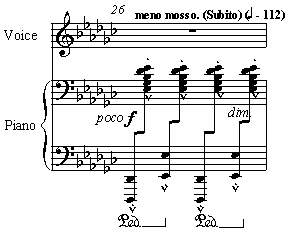
The minor-seventh-chord (also a symmetrical collection based on the pentatonic scale) is similarly treated in the final verse. In bars 26-37 the accompaniment is exclusively harmonised by the minor-seventh-chord (E𝄭, G𝄭, B𝄭 & D𝄭), which accentuates the basic pentatonic substructure of the entire song.
Ex. 3.13: Eight Hungarian Folksongs, No. 3, bar 26.
The fifth setting (If I climb Yonder Hill), based on the E-Pentatonic scale, goes a stage further than the modal extensions previously examined. Antokoletz shows how Bartók goes “beyond the limits of the polymodal chromaticism of the preceding songs.”92 Similarly to the other songs of this group, the starting point is an opening statement of the minor seventh (pentatonic substructure) chords. At bar 5, the pentatonic modal collection is transformed into a symmetrical series of root position triads based on the whole tone scale (Ex. 3.14).
Ex. 3.14: Eight Hungarian Folksongs, No. 5, bars 5-7.
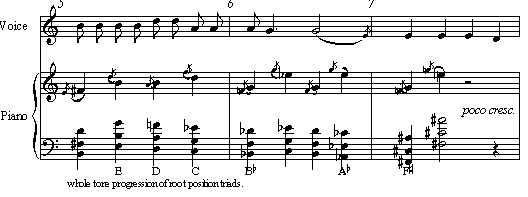
Antokoletz points out that the cycle of fifths in the two lower voices starts out from the pentatonic notes (B, E, A, D & G), which is a point of reference for most of the material of the piece:
Thus, the E-pentatonic pitch content of the folk tune serves not only as an invariant symmetrical structure without polymodal chromaticism (E-Phrygian, E-Dorian, and E-Aeolian) but also as a point of departure for the generation of larger sets of interval cycles (two whole-tone scales and a cycle of fifths). This foreshadows a new means of progression in Bartók’s later works.93
Vera Lampert draws attention to another interesting feature of the fifth song, which is the use of an instrumental variant in the sections where piano is heard alone. This illustrates the growing importance of piano as an equal partner to the vocal line. Both the third and the fifth songs demonstrate Bartok’s interest in variation-form and his need to incorporate folk material in his large-scale structures. Lampert points out that the set is presented as a cycle with songs grouped into movements: “slow-slow-fast; slow-fast; slow-fast-fast.”94 This foreshadowed the more extensive assimilation of folk music and classical forms that took place in later collections like Village Scenes (1924) and Twenty Hungarian Folksongs (1929).
Piano Arrangements
In 1907 Bartók was given the chair of piano teaching at the academy of music in Budapest. This period was marked by his interest in compositions for piano that expressed two frequently coinciding aims:
(1) His desire to forge a new individualistic musical language.
(2) The need for a repertoire of pedagogical music to fulfil his teaching duties.
His important discoveries as an ethnomusicologist were to inspire keyboard creations and it was through piano music that the spirit of folk music was assimilated into his art.
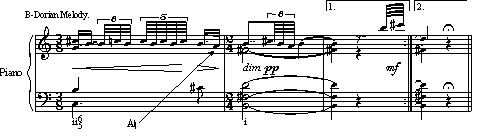
His first arrangements for piano were Három Csík Megyei Népal [Three Hungarian Folksongs from the Csík District] (1907). These simple settings were composed along similar lines to the Twenty Hungarian folksongs. The first song illustrates Bartók’s interest in variable tempo rubato rhythm with its flowing ornamental line. Similarly to the vocal settings, he uses harmonies that are derived from modal characteristics. In the first song the B-Dorian melody is lacking the major seventh degree; consequently the dominant/tonic function is lacking.
Ex. 3.15: Three Hungarian Foksongs from Csík, No. 1, bars 14-17.
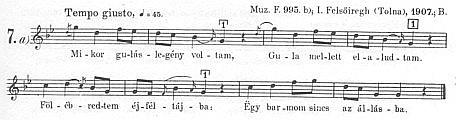
In 1908 Bartok mixed folk settings and free composition in The Fourteen Bagatelles Op. 6. This volume of short pieces was a milestone in Bartók’s development as a composer, as it combined his interest in deriving new pitch structures from folk music and his own individual musical conceptions. It also coincided with his discovery of parallels between Debussy’s music and folk music. The majority of the pieces are original compositions with the exception of No. IV and No. V. No. IV, a setting of a melody from the Tolna province of Hungary, is a good example of Bartók’s liking for the minor-seventh-chord.
Ex. 3.16: Hungarian Folk melody arranged by Bartók in Bagatelle No. IV.
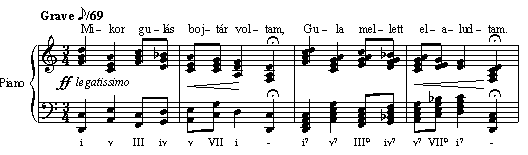
In the first phrase, simple triads accompany the D-Aeolian melody and the seventh degree is added to each chord in the second phrase, creating a sequence of minor-seventh-chords (Ex. 3.17). Antokoletz describes this experiment:
The parallel motion of these root-position chords contributes to the equalization of the chordal tones, by eliminating the necessity for logical preparation or resolution of any of the tones in terms of traditional voice-leading.95
The pentatonic bass line further weakens the tonal function, with its characteristic absence of semitone steps.
Ex. 3.17: Fourteen Bagatelles, No. IV, bars 1-4.
Bartok scholars have all drawn attention to the importance of the Bagatelles, as an important juncture in his rejection of the conventional principles of harmony. Bartok combined the use of modal folk music with experimental use of dynamics, rhythm and piano sonority.
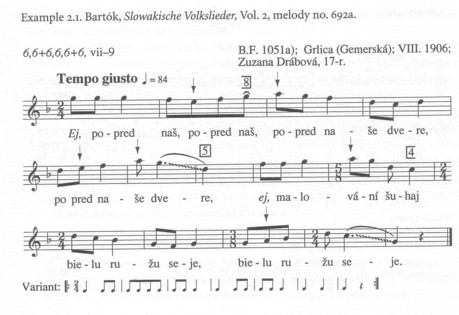
Unconventional use of piano sonority can be found in Bagatelle No, V, which is a harmonisation of a Slovakian melody.
Ex. 3.18: Slovakian Folk Song arranged by Bartók in Bagatelle No. V.
Bartók harmonised the first 27 bars with a single minor-seventh-chord (G, B𝄭, D, F) (Ex. 3.19). This chord reflects the primary notes of the melody and projects as Antokoletz points out “a vertical (harmonic) ordering from the melodic contour.”
Ex. 3.19: Fourteen Bagatelles, No. 5, bars 5-11.
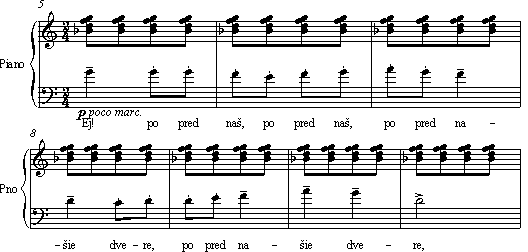
This harmonic procedure can be compared with serialism, where vertically presented melodic cells generate harmony texture. The difference is that Bartok does not depart entirely from diatonic functions of modes and their ability to assert a sense of tonic key.
Bartók incorporated folk song settings into two other collections of piano pieces that were intended as companion volumes to the Bagatelles (Ten Easy Pieces (1908) and Seven Sketches (1908-10).
Bartok subsequently turned his attention to folk music for didactic purposes. These collections concentrated on settings of Slovakian and Romanian music for piano. The arrangements in For Children (1908-10), a volume of Hungarian and Slovak melodies, exhibit similar harmonic tendencies to the Bagatelles. Suchoff draws attention to no. 18, vol. 1, because of its use of the D-Lydian/Phrygian, twelve-note polymode. Likewise, No. 39, vol. 2, is a good example of E-Phrygian/Lydian polymodal chromaticism, use of parallel fifths and unresolved dissonance.96
After a considerable hiatus in his compositional output Bartók turned his attention to Romanian music and 1915 he produced two collections, Romanian Christmas Songs and Romanian Folk Dances. The settings of Romanian colindǎ (Christmas carols) are interesting because of their distinctive melodic and rhythmic characteristics. János Kárpáti demonstrated how Bartók retained the “asymmetrical quality of meter” (Ex. 3.20).97
Ex. 3.20: Romanian Christmas Carols, No. II, bars 1-7.
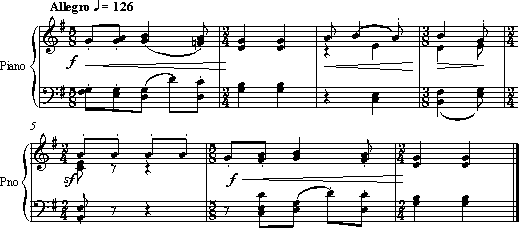
Kárpáti writes:
This rhythmic concept must have been a major discovery for Bartok since it was obviously at variance with the metric structure of most European music, where the structuring of time is predominantly ‘divisive’, with larger temporal units being divided into smaller, equal ones. 98
As I will demonstrate in chapter 5, many of Bartók’s original works exhibit the rhythmical freedom characteristic of these Romanian melodies.
In the following chapter I will illustrate how some aspects of Bartók’s approach to the harmonisation of folk melodies influenced his own original music.
Chapter 4: Folk Music and the Abstract Musical Language
This chapter will examine the extent to which Bartók synthesised elements that were derived from his interaction with folk music. In Bartók’s mature works these elements evolve into what Antokoletz calls “a highly complex and systematic network of divergent chords and scales.”99 In attempting to show the relation of folk music to Bartók’s creative music concepts, I concentrate on important techniques central to the early compositional idiom. I will analyse Bartók’s use of modality, demonstrating its influence on the symmetrical intervallic constructions of abstract music. It will be the purpose of this discussion to concentrate on Bartók’s early collections of piano music, Fourteen Bagatelles op. 6 (1908), Ten Easy Pieces (1908) and Sketches op. 9b (1908-10).
In his Harvard lectures Bartók explained the difference between his concept of harmonic dissolution and that achieved by the dodecaphonic composers: Schönberg, Webern and Berg. He described a contrast between works based on an atonal system and works fixed in a concept governed by tonal centricity:
To point out the essential difference between atonality, polytonality, and polymodality, in a final word on this subject, we may say that atonal music offers no fundamental tone at all, polytonality offers – or is supposed to offer – several of them, and polymodality offers a single tone. Therefore our music, I mean the new Hungarian art music, is always based on a single fundamental tone, in its sections as well as in its whole.100
This illustrates how Bartók related chromatic pitches to modal pitch sets with common fundamental notes. As was demonstrated in the previous chapter, Bartók used a system combining two or more modal segments, based on a single fundamental pitch, which enabled him to use all twelve pitches of the chromatic spectrum. This system retains the fundamental tone as a point of reference, rather than a fundamental in the traditional hierarchical sense. This technique is not concerned with atonality, but a rejection of harmony in favour of a new way of establishing tonal priority. As was shown in the previous chapter, this technique was used to enrich the harmonic language of simple modal folk tunes. Bartók’s rather more complex and variegated approach to polymodal interaction of his original works is demonstrated by his comments:
In our works, as well as in other contemporary works, various methods and principles cross each other. For instance, you cannot expect to find among our works one in which the upper part continually uses a certain mode and the lower part continuously uses another mode. So if we say our art music is polymodal, this only means that polymodality or bimodality appears in longer of shorter portions of our work, sometimes only in single bars. So change may succeed from bar to bar, or even from beat to beat in a bar.101
It is important to note that Bartók’s ideas were not developed in isolation from other developments in European art-music: he acknowledged that this compositional trend was not only limited to the new Hungarian art music, but was also influenced by other composers affected by the folk idiom. An important event in Bartók’s development as a composer was his discovery of Debussy’s whole-tone scales and pentatonic formations, which he felt gave “valuable hints for future possibilities.”102 He writes in his essay “Autobiography” about the common bond between composers linked to folk tradition:
In 1907, at the instigation of Kodály, I became acquainted with Debussy’s work, studied it thoroughly and was greatly surprised to find in his work ‘pentatonic phrases’ similar in character to those contained in peasant music. I was sure these could be attributed to influences of folk music from Eastern Europe, very likely from Russia. Similar influences can be traced in Igor Stravinsky’s work. It seems therefore that in our age, modern music has developed along similar lines in countries geographically far away from each other. It has become rejuvenated under the influence of a kind of peasant music that has remained untouched by the musical creations of the last centuries.103
These discoveries coincided with Bartók’s examination of the modal and pentatonic structures of his native Hungarian folk music. Bartók’s free compositions written after this period are an attempt to synthesize these elements and provide a cohesive framework for the construction of new works.
In 1907 Bartók was appointed chair of piano teaching at the Academy of Music in Budapest. His activities in 1907 led to a series of original piano works that formed the basis of a new style. These were published as collections of short pieces, the earliest of which was the Fourteen Bagatelles op. 6. Bartók described them in 1945:
A new piano style appears as a reaction to the exuberance of the Romantic piano music of the nineteenth century; a style stripped of all unessential decorative elements, deliberately using only the most restricted technical means. 104
He was evidently aware of the importance of the place of the Bagatelles in his compositional development when he said that: “the Bagatelles inaugurate a new trend of piano writing in my career.”105 He wrote in a letter of 1910 that after writing the Bagatelles:
I have regained some inner “harmony,” so that today, I am not need of contradictory accumulation of dissonances which express that mood. This may be a consequence of allowing myself to become more and more influenced by folk music 106
Many Bartók scholars have emphasised the importance of the Bagatelles in the wider context of the turn-of-the-century modernist movement. Stevens points out that Bartok was ahead of his contemporaries:
The Piano music of 1908 shows experimentation with bitonality, dissonant counterpoint, chords in intervals other than thirds, somewhat before the works of Stravinsky and Schoenberg in which these devices first came to light.107s
Elliot Antokoletz, who uses the Bagatelles as the basis of his study The Music of Béla Bartók (1984), points out that they were “one of the earliest sets of pieces to discard the triad as the exclusive harmonic premise.”108 The originality of these pieces was highlighted by Ferruccio Busoni’s words of praise, which were included in an advertisement for the first edition published by Károly Rosznyai in 1909:
I hold these pieces to be among the most interesting and original of our time; what the composer has to say is out of the ordinary, and entirely individual.109
These pieces parallel the dissolution of tonality found in the early music of Arnold Schönberg. There are strong parallels between the Bagatelles and Schönberg’s op. 11 piano pieces composed the following year. They mark an important transition from the youthful style to Bartók’s more individualistic mature style found in later works. Victoria Fischer, author of an article on the Bagatelles, points out that these pieces are a “microcosm” of Bartók’s mature style and contain seeds of what was developed in later compositions.110
Other collections subsequently published by Bartók, Seven Sketches op. 9b, and Ten Easy Pieces, also all illustrate various levels of compositional treatment Bartók used for the accompaniment of folk music, as well as techniques for the creation of original music. A method quite common to all these collections is the pedagogical exploration into a limited use of technique. These studies can indeed be interpreted as the seeds of composition, revealing the basic constructions of Bartók’s musical oeuvre, which later developed into more complex interactions. On one level these works reveal Bartók’s interest in a pedagogical approach to composition, and on another they are an exposition of his early experimental ideas, which took shape in his larger scale compositions.
In Bagatelle no. 1, polytonality is the main feature of the musical language and the piece is notated in two key signatures, which Bartók says is a “half-serious, half-jesting procedure” designed to make fun of the use of key signatures in contemporary music.111 The top stave has four sharps implying C-minor, and the lower stave has four flats implying F-minor. In his analysis of this piece Bartók rejects a polytonal interpretation, which asserts the existence of two keys operating simultaneously. He states unequivocally that the tonality is “simply a Phrygian coloured C major.”112 This statement supports a polymodal rather than the polytonal interpretation. In his Harvard lectures Bartók explains the inability of the ear to perceive two or more different keys simultaneously. He points out that the ear selects one key as the fundamental and “will project the tones of the other keys in relation to the one selected.”113 In other words, the pitches of one key will be heard as altered tones of a second key.
Antokoletz’s analysis shows that the upper line has characteristics of C♯-Aeolian superimposed over descending C-Phrygian segments. At the most prominent cadential points the C-Phrygian and C♯-Aeolian modal lines coincide on the dyad C-E, implying C major tonality (Ex. 4.1).114 It is clear that Bartok intended to assert the priority of Phrygian coloured C-Major without resorting to traditional dominant-tonic chordal functionalism. It is interesting to note that the only pitch missing from the twelve-note spectrum is D♮, which tends to emphasis the flattened second Phrygian colouring.
Ex. 4.1: Bagatelle No. 1, Bars 1-12.
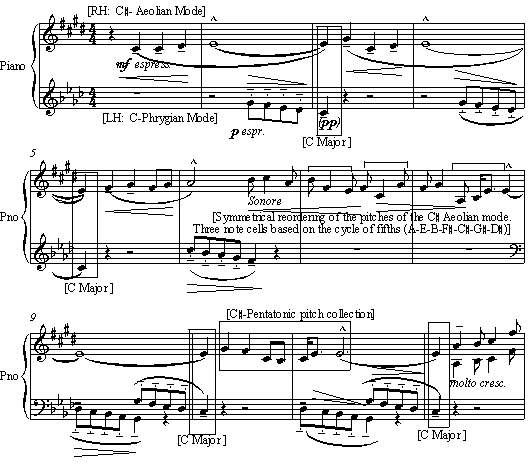
Bagatelle No. 1 demonstrates the use of melodic and harmonic symmetries, which equalise the notes of the diatonic mode. Antokoletz points out that the C♯-Aeolian mode is gradually transformed in this piece into reordered, three-note segments of the cycle of fifths.115 The second segment (F♯-C♯-G♯) is presented in its symmetrical cyclic order (bar 7). This process is intensified in the second section, where a six-note sequence of descending fourths is unfolded (E-B-F♯-C♯-G♯-D♯) (bars 13-14).
Ex. 4.1: Bagatelle No. 1, bars 13-18.
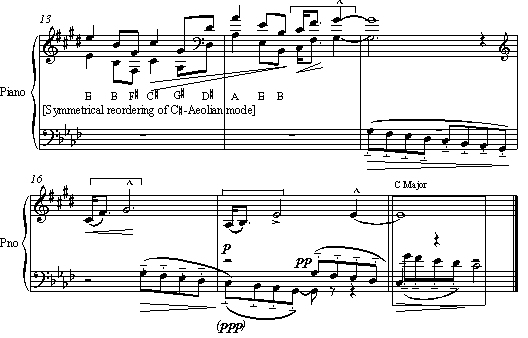
In bars 10-11, another symmetrical construction is used as the upper line is derived from a C-pentatonic pitch collection. I have shown in the previous chapter that fourth chords, which can also be rearranged as a cycle of fifths, are related to the pentatonic scale (Ex. 3.10). In light of this fact, I can demonstrate that the pentatonic label applies equally as well to the three-note groups in bars 7-8 and 13-17. To a large degree the intervallic constructions of this piece are influenced by the symmetrical pentatonic properties of folk music. In bar 12, the upper line uses another symmetrical ordering (E-A-B-C♯-F♯). These symmetries weaken the tonal hierarchy, creating a sense of tonal stasis. Bartok warns us that an attempt to apply tonal interpretations is to “pigeonhole all music” that we do not understand. The music is better understood as a complex interaction of scales, chords and pitch collections.
Bartók’s approach to polymodality is also well demonstrated in the second of his Seven Sketches op. 9b. In bars 1–4 an E-minor triad is simultaneously sustained in the right hand with the A𝄭 major tetrachord of the left hand.
Ex. 4.2: Seven Sketches, Op. 9b, bars 1-5.

These chords belong to separate C-Lydian and C-Phrygian modal collections, which together form a twelve-note polymode.
Ex. 4.3: C-Phrygian/Lydian Polymode.

Implicit in the opposition of major and minor chords is the suggestion of a child’s see-saw implied in the title of the work, “See-Saw, Dickory-Daw”. This alternation of major and minor chords is the basis of the piece until bar 16. Here the unison texture adopts a C-Aeolian modality stressing the flattened seventh degree. Suchoff points out that these final bars mark an abrupt change in tonality as a new polymode is constructed out of the fusion of the pitches of C-Lydian and C-Aeolian modes.116 This is emphasised by the use of the note G𝄭, an interval of a diminished fifth from the tonic C.
Ex. 4.4: Seven Sketches, Op. 9b, No. 2, bars 17-20.
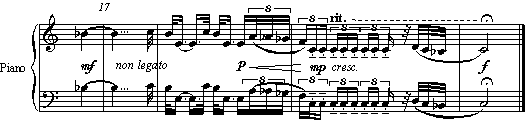
In asserting “its tonality is indisputably a pure C major,” Bartok resisted a bi-tonal explanation of this work.117 However, the use of the key C major is unconventional in a traditional sense, as the key asserts itself by the conjunction of two diverse pitch collections based on a common fundamental. The chromatic pitches are best understood as the diverse ingredients of different modal materials. This procedure is similar to the methods of polymodal harmonic construction demonstrated in the previous chapter.
As was demonstrated in Bagatelle no. I, Bartók transforms modal material, concentrating on abstract symmetrical formations, which are treated like melodic cells. Antokoletz points out that:
The new means of providing coherence in an idiom based on equalisation of the semitones is primarily found in the intervallic pitch cells.”118
The folk music precedent comes from Bartók’s interest in the symmetrical relations in the intervals of the pentatonic scale and the resultant minor-seventh-chord.
Ex. 4.5:Hungarian Pentatonic Scale.
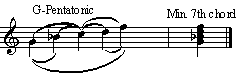
A good example of the non-functional use of minor-seventh-chord can be found in the final four bars of Bagatelle No. XIII. Bartók juxtaposes two minor-seventh-chords a tritone apart, which demonstrates the use of the augmented fourth/diminished fifth as a sort of substitute dominant (Ex. 4.6). The tritone is a symmetrical division of the octave into two halves. Antokoletz points out that the pitches are derived from a complete octatonic collection (E𝄭-E-G𝄭-G-A-B𝄭-C-D𝄭).119 These chords are treated like harmonic motives rather than a conventional chordal progression.
Ex. 4.6: Bagatelle No. XII, bars 23-26.
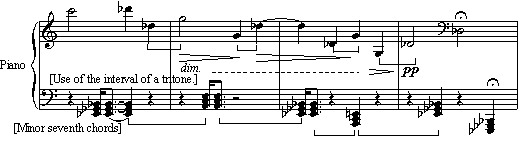
The final E𝄭 minor seventh chord, which is the point of rest on which the piece finishes, is given a consonant role. As I have demonstrated in the previous chapter, this unconventional practice was derived from the symmetrical relations of the pentatonic scale.
Bartók also applied symmetrical concepts to more abstract formations based on non-diatonic pitch collections. In Bagatelle no. 3, he uses a chromatic scale segment, which is repeated as a right hand ostinato figure. The left hand symmetrically expands the cluster by emphasising a tritone boundary interval (F♯-C).
Ex. 4.7: 14 Bagatelles, No. II, bars 3-6.
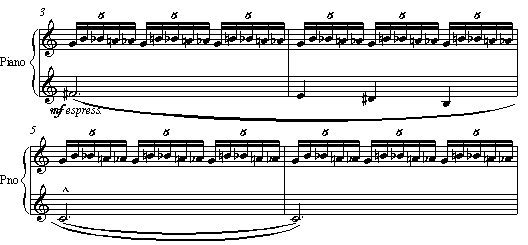
New pitches are added at bar 12 (C♯) and bar 18 (D), which finish a complete statement of all twelve chromatic tones. The use of the tritone interval (F♯-C) emphasises the underlying Lydian tonality, which belongs to the C-Lydian/Phrygian twelve-note polymode. C major tonality is emphasised by motion from leading-note to tonic, which occurs at important cadential points.
In the finger study, Ten Easy Pieces, IX, Bartok uses a similar ostinato figure constructed from the notes of the whole-tone scale.
Ex. 4.8: Ten Easy Pieces, No. IX, bars 5-8.
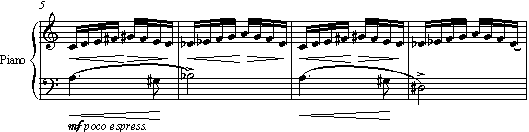
In bars 5-8, the music alternates between two whole-tone segments a semitone apart (Ex. 4.8). In the bass clef, the interval A-B𝄭 (bar 5-6) operates as a symmetrical expansion of the first whole-tone cluster, emphasising the flattened second of the A-Phrygian mode. The melodic interval of a tritone, A-D♯ (bars 7-8) emphasises the A-Lydian mode. It can be asserted that the chromatic material of this piece is derived from the A-Lydian/Phrygian polymode. The tonal priority of A is emphasised by its use as an important final cadential note (bar 41). In the final section an A-C dyad is superimposed over two whole-tone tetrachords (D♯-C♯-B-A and F♯-E-D-C), emphasising the tritones, D♯-A and F♯-C. Antokoletz used the label “Y-cell” to describe this symmetrical tetrachord, which is constructed from the first four degrees of the Lydian mode, outlining an augmented fourth interval.120
Ex. 4.8: Ten Easy Pieces, No. IX, bars 41-51.
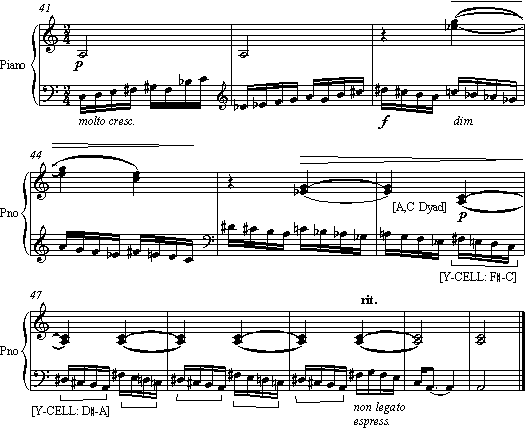
The whole-tone scale is treated in an experimental manner in Seven Sketches, no.3. In bars 1-5, the principal pitches of the melody are derived from a whole-tone segment (A𝄭-F♯). This is a good example of Bartók’s syntheses of whole-tone scales with his Phrygian/Lydian, polymodal chromaticism.
Ex. 4.9: Seven Sketches, Op. 9b, No. 3, bars 1-5.
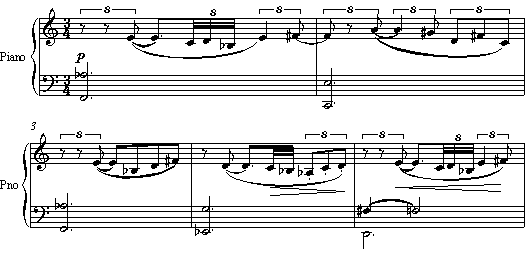
A similar use of the whole-tone scale can be found in Seven Sketches, no. 7. The second half of this piece superimposes two whole-tone pentachords A-E♯ and F♯-C𝄪 (in parallel motion), which are a major sixth apart (bars 17-22).
Ex. 4.10: Seven Sketches, Op. 9b, No. 7, bar 17.
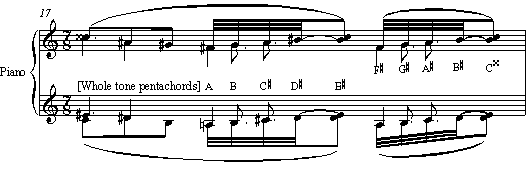
The combination of pitches is derived from a ten-note segment of the chromatic scale. In the final bar, Bartok uses the whole-tone pentachords as vertical cluster chords. The tonal priority of A is asserted by its prominence as the lowest note of the pentachord formations. In this piece Bartok synthesises whole-tone scales with the chromaticism of the A-Phrygian/Lydian polymode.
Ex. 4.10: Seven Sketches, Op. 9b, bar23.
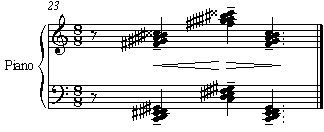
Another symmetrical tetrachord used in Bartók’s Ten Easy Pieces, no. II is the Z-cell121, which is made up of two semitone intervals separated by a perfect fourth. In bars 3-6, Bartók superimposes a D-Dorian melody over a D-Z-cell ostinato in the bass clef.
Ex. 4.11: Ten Easy Pieces, No. II, bars 3-6.
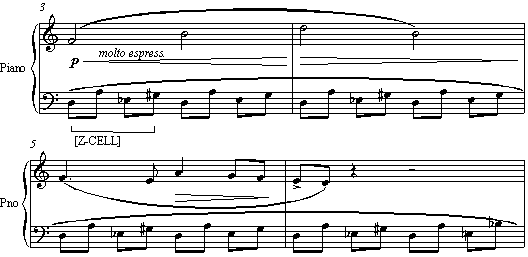
In bars 7-9, Bartók uses an F-Z cell transposition, and it can be shown the D-Z cell and F-Z cells are related by their common derivation from a complete octatonic collection. This piece is a good example of Bartók’s synthesis of modal, chromatic and octatonic collections, which are all derived from the twelve-note Lydian/Phrygian polymode.
Ex. 4.12: Combination of two Z-cells to create octatonic collection.
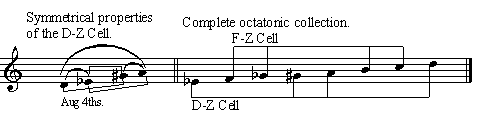
Antokoletz (in his study of Bartók’s piano music) stresses the importance of the octatonic scale, demonstrating that by extending diatonic modes, one can form a complete octatonic collection.
While the diatonic extensions themselves appear as one or another of the church modes in authentic folk melodies, the octatonic extensions represent abstract formations of the original non-diatonic folk sources. In addition, in certain instances in Bartok’s music, whole-tone scales may be understood as abstract extensions of one or another of the folk modes. All these extensions, whether or not they can be found among the authentic peasant melodies (the completed octatonic and whole-tone scales cannot), are exploited both melodically and harmonically by Bartók as pitch sets, that is, as divorced from traditional tonal functions.122
Antokoletz uses an example of a non-diatonic mode (Ex. 4. 13), quoted by Bartók in his Harvard lectures (See Ex. 3. 6), to show the convergence of scale types in a folk music structure.
Ex. 4.13: Non-diatonic Folk mode.
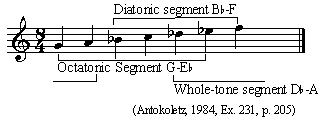
The primary focus of this analysis is to show the interaction of octatonic, whole tone and diatonic scales. Whether the octatonic scale is a pre-compositional source is open to debate, as Bartók does not refer to it directly. It is an effective analytical tool, as it becomes a way of linking abstract formations with the contextual properties of diatonic scales. The octatonic scale encompasses several pitch collections and is a useful frame of reference for the combination of diverse harmonic types.
A good example of Bartók’s early use of the octatonic scale is found in Bagatelle number XI. In this piece he superimposes an octatonic scale over a sequence of fourth chords (Ex. 4. 14). These chords are based on a re-ordering of the cycle of fifths (F-C-G-D-A-E-B), which is related to the diatonic structure (C-D-E-F-G-A-B). This is a good example of the use of the symmetrical fourth chord, which Bartók derived from the frequent skip of the interval of a perfect fourth found in Hungarian folk melodies.123 It is a significant shift away from the use of the triad as the basic harmonic premise of a piece. The combined effect of these two diverse pitch collections is tonal stasis, which lacks traditional functional chordal progression.
Ex. 4.14: Bagatelle No. XI, bars 26-29.
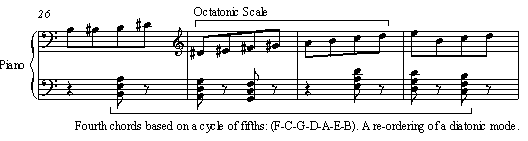
The final dissonant chord, containing a diminished fifth, which remains unresolved, reinforces this effect. The tonality is indecisive and taken as a whole it exhibits Bartók’s tendency towards a fusion of different elements derived from the symmetrical properties of folk music.
Ex. 4.14: Bagatelle No. XI, bars 83-88.
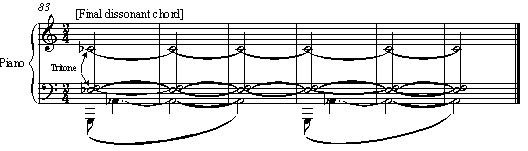
This examination of Bartok’s early music now leads into chapter five where I will examine how Bartók absorbed these techniques into his mature style.
Chapter 5: Synthesis in the Mature Works
In this chapter I will take a kaleidoscopic look at Bartók’s mature compositions. The purpose of the discussion will be to show how Bartók continued to be influenced by elements originating from his experience of folk music. I shall examine these influences, which continued to permeate his musical language through to the very end of his life, showing how Bartók expanded his ideas of arrangement to the point where he assimilated folk music into more large-scale and sustained forms.

In the years 1918-1920, Bartók embarked on what Malcolm Gillies calls “his most radical, Expressionist phase, during which he believed he was approaching some kind of atonal goal.”124 In the essay “The Problem of the New Music” (1920), Bartók charted the development of atonal music leading up to the developments of the dodecaphonic method. Bartók’s comments indicate that he was greatly influenced by the equalisation of the chromatic scale.
The possibilities of expression are increased in great measure, incalculable as yet, by the free and equal treatment of the twelve tones.125
Bartók gave examples of adjacent dissonant note sonorities, suggesting a more varied approach to atonality than the dodecaphonic methods of his Viennese colleague Arnold Schoenberg. He proposed the retention of certain features of the tonal system such as triads and scale constructions. As isolated occurrences they do not infer a sense of tonality. The most obvious musical parallel to these ideas was Bartók’s The Three Studies, op. 18 (1918) for piano, which is undoubtedly one of Bartók’s most radical creations. Paul Wilson points out that the products of this period (The Miraculous Mandarin op. 19 (1918-19) and the First and Second Violin Sonatas (1921 and 1922) “employ a harmonic language which greatly modifies and often abandons the modal and polymodal basis of Bartók’s previous and subsequent works.”126
Bartók’s Improvisations for Piano, op 20 (1920) are generally paired with The Three Studies, linking his ideas of folk music arrangement with atonal tendencies of this period. In his Harvard lectures Bartók commented on this work:
In my Eight Improvisations for Piano I reached, I believe, the extreme limit in adding most daring accompaniments to simple folk tunes.127
Paul Griffiths points out that it was with the improvisations that “the distinction between arrangement and original composition is beginning to break down.”128 Bartok introduced a method, involving the treatment of folk tunes as “mottos,” which are repeated against different accompanimental backgrounds. In his , “The Influence of Peasant Music on Modern Music” (1931), Bartók contrasts this way of working with the techniques utilised in his earlier folk arrangements (1907-18).
In one case accompaniment, introductory and concluding phrases are of secondary importance, and they only serve as an ornamental setting for the precious stone: the peasant melody. It is the other way round in the second case: the melody serves as a ‘motto’ while that which is built around is of real importance.129
Bartok used the following example from his third improvisation (bars 16-30) to illustrate this point. The folk melody appears in the lower stave (bar 19) set against a dense accompanimental texture (Ex. 5.1).
Ex. 5.1: Improvisations op. 20, no. 3, bars 16-30.
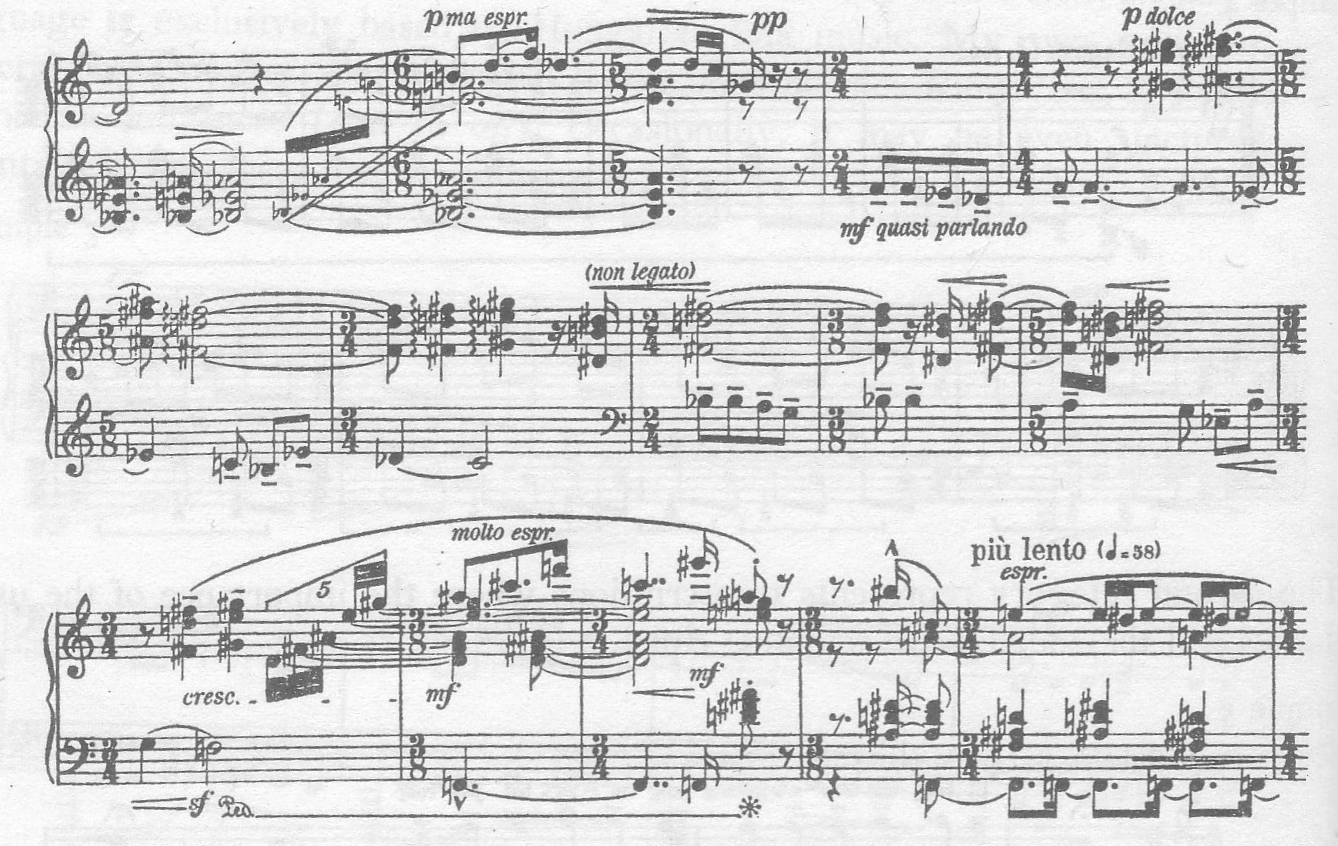
Bartok distanced himself from the more restrictive dimensions of folk music by trying to overcome what Schoenberg called “the discrepancy between the requirements of larger forms and the simple construction of folk tunes.”130 This is achieved in the Improvisations for Piano, op. 20, by synthesis of folk music material into more expansive formal plans. Paul Wilson points out that the eight movements can be grouped together in four units:131
1 | 2 | 3 | 4 |
Nos. 1-2 | Nos. 3-5 | No. 6 | Nos. 7-8 |
Modal final: G | Scherzo like. | Modal Final: C |
Wilson shows that the first piece of each section begins with a setting that is closely derived from the folk tune.132 He describes how the opening bar of the first improvisation contains a melodic interval of a major second (F-E𝄭), which dominates the accompanimental texture of the following bars. The derivation of vertical harmonic structures from melodic lines is utilised as a method of motivic integration. At the ends of each of the sections outlined by Wilson this integration is abandoned in favour of a freer accompanimental technique. With the exception of no. 6, the tempo for each section progresses from fast to slow. The common final notes of G and C link the pieces 3-5 and 7-8 respectively. These important links between musical events show that Bartók was thinking of a more expansive structural coherence, a feature that was entirely absent from his earlier collections.
A similar approach is adopted in Village Scenes for Voice and Piano (1924), which is a five-movement setting of Slovak ceremonial songs. Vera Lampert points out that these songs represent Bartok’s second category of arrangement: “the original melodies submit themselves to the logic of the composition.”133 Again Bartók uses a “motto” like procedure to develop the accompanimental material, achieving a balance between voice and piano. Similarly to the Improvisations Bartok exhibits the tendency to combine folk melodies within a larger framework, circumventing the formal restrictions of the medium. Vera Lampert writes:
In the third and fourth movements Bartók experimented with expanding the formal possibilities in the folk song arrangement, taking two folk melodies as the basis of a single movement and organising them into simple classical forms.134
This can be demonstrated by tabulating movement three and four, which reveal Bartók’s use of simple classical forms such as Rondo and Ternary.
Movement | Form | Tabulation |
3:Wedding Songs | Rondo with piano interludes | XAxBxAxBABx |
4: Lullaby | Ternary | AABBBA |
This tendency towards structural synthesis of folk tunes is not so apparent in Bartók’s last collection of folk settings for voice and piano. The collection, Twenty Folksongs for Voice and Piano (1929), is grouped into four volumes entitled: Sad Songs, Dancing Songs, Diverse Songs, and New Style Songs. Unlike Village Scenes, the folk songs are presented as self-contained entities, grouped together in one big cyclical creation. Rather than being a fusion of different melodies, form is extended by repetition, and in some cases up to six stanzas are used. Variation in the accompanimental texture is maintained with a system of through-composition, which is used consistently. Lampert points out the importance of Bartók’s creation:
With the Twenty Hungarian Folksongs of 1929 the emancipation of the folksong arrangement within the realm of original composition had reached a new stage.135
Bartok deviated from all of his previous methods of folk arrangement, but like the Improvisations, op. 20, he established a fixed point of reference with his use of the “motto” function. The aim to incorporate folk music into a larger structural framework can be demonstrated by the structural continuity of accompanimental texture, which is maintained throughout this collection. An example of this can be found in the final volume of songs, where Bartók uses a motivic link (a descending, and sometimes ascending scale) to accentuate the cyclical unity of the group (Ex. 5.2). Rachel Beckles Willson writes:
Sketches reveal that Bartók carefully reinforced the songs’ unity in this way. He revised the third central song to interpolate not only a piano interlude based on retrograde of the main scale passage of the melody, but also a descending scale passage over ten degrees in counterpoint with the voice’s preceding verse.136
Ex. 5.2: The scale motive in Twenty Folksongs, Vol. 4.
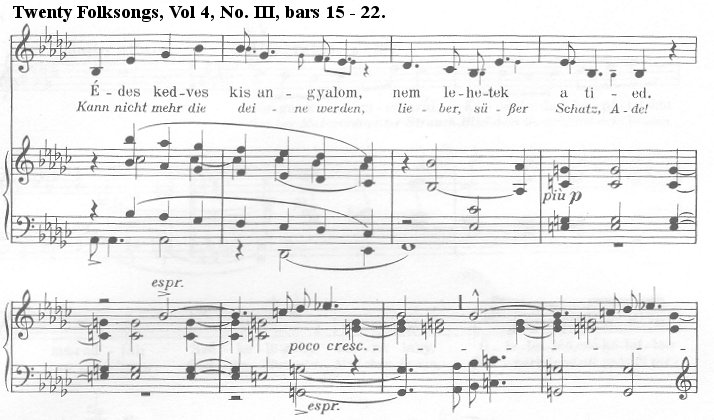
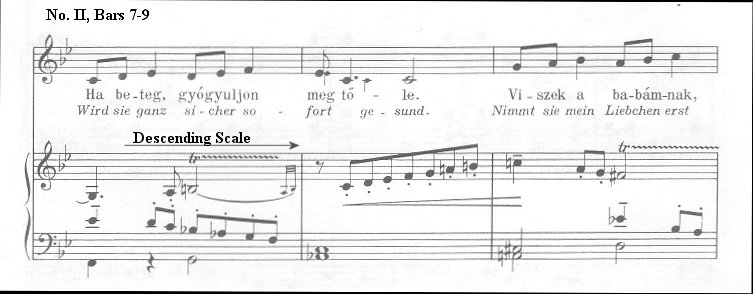
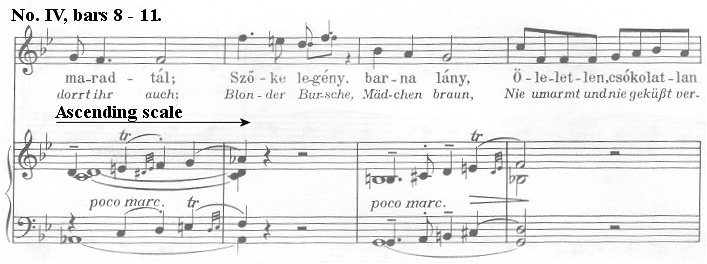
Twenty Folksongs for Voice and Piano could also be classified as art-music, as Bartok gives his accompaniment an expressive quality typical of a conventional song cycle. Griffiths points out that there is sometimes an apparent divergence between the melody and accompaniment. The tunes “are set in relief, by divergences of melody, harmony and rhythm.”137 Other commentators such as Lambert have drawn attention to Bartók’s preoccupation with the linear counterpoint. Bartók, who had visited Italy in 1925 and 1926, had engrossed himself in Italian Baroque keyboard music. This influence is certainly of significance, as these works exhibit a much greater degree of horizontal counterpoint than is found in Bartók’s earlier arrangements. In Twenty Folksongs folk music and the linear counterpoint are inseparable, as they both become interrelated elements.
The Hungarian musicologist Bence Szabolcsi has drawn attention to an apparent conflict in Bartók’s work. He quotes a statement made by Bartok to Denjis Dille in 1937:
The ‘absolute’ musical forms serve as a basis for a freer musical formula even if these formulae involve characteristic melodic and rhythmic types. It is clear, however, that folk melodies are not really suited to be forms of ‘pure’ music, for they, especially in their original shapes do not yield to the elaboration which is usual in these forms. The melodic world of my string quartets does not differ from that of folk songs: it is only their setting that is stricter. It has probably been observed that I place much of the emphasis on the work of technical elaboration, that I do not like to repeat a musical thought unchanged, and I never repeat a detail unchanged. This practice of mine arises from my inclination for variation and for transforming themes […] the extreme variety that characterises our folk music, at the same time, a manifestation of my own nature.138
Based on the above quotation Szabolcsi describes an opposition of forces that is discernible in Bartók music. On one hand, the unconscious element, which is “an aspiration related to the ever-changing, shaping nature of folk music.” And on the other, the conscious element, which asserts itself as the requirement for a “strict framework, the tendency for concentration, for unity and distilling.”139 Both of these forces act as counter weights and are constantly shaping each other.
After an initial phase of discovery (1907-1918), Bartók’s ethnomusicological work entered a period of analysis, which lasted to the very end of his life. Griffiths points out that during the period from 1904 to 1918, Bartók’s original music was at its most immediate and uncontrolled. As ethnomusicological activities became more analytic, his original music followed a similar path.140 This constant reassessment of folk music sources made their grammar and syntax almost second nature to Bartók, and it is not surprising that out of this he formed a deeply intuitive level of compositional activity. The above statement reveals that, as an original composer, Bartók was influenced, not by only actual melodies, but by the inherent logic of folk music. He acknowledged the need to derive structures, by which to control these influences. Griffiths charts Bartók’s development as a composer as “first a period of close involvement and direct transcription, then a time of analysis and deeper creative connections.”141
To Bartók’s three categories of folk music arrangement (mentioned in chapter three), Benjamin Suchoff adds a further two levels of folk influence, which define his approach to free composition.
(4) The composition is based on themes, which imitate genuine folk tunes.
(5) “Neither the folk tune is used, but the work is nevertheless pervaded by the ‘spirit’ of folk music”142
Bartók makes a distinction between the macroscopic use of melody and the microscopic assimilation of techniques: “in my original works they [folk tunes] have never been used.” He goes on to say: “if there is no indication of origin, then there have been no folk melodies used at all.” The influence of folk music, Bartók states, “is largely a matter of intuitive feeling, based on some kind of experience of folk music material.”143 In the vast majority of Bartók’s original compositions, folk music influences are of the later variety, adopting the spirit of the music rather than quoting tunes or deriving synthetic equivalents.
It will be my purpose in the remainder of this chapter to look at some of the most obvious connections between folk music and Bartók’s mature works. Each of these will be listed according to separate categories.
Form and Variation
Bartók’s famous statement to Denjis Dille illustrates the importance he placed on the variational procedure, which he derived from folk music. Throughout his lifelong career as an ethnomusicologist, Bartók continually strove to improve his methods of transcribing, and after 1934 (the date of his appointment to the Academy of Sciences in Budapest) he was better able to notate the living form of folk music. These transcriptions demonstrate the tendency among performers of folk songs to alter musical material upon repetition. This process is largely intuitive and is expressed in several different ways. It could take the form of variation of a melody in successive verses of a song, or it may take the form of long-term change with the process of oral transmission generating variants of the same tune. In any case, variation is an intuitive instinct of the folk musician and an important means to express individuality in a collective musical expression. This point can be demonstrated with reference to a transcription of a Romanian melody Bartók collected in 1913 (Ex. 5.3).
Ex. 5.3: Bartók’s holograph of melody No. 79e from Vol. II (Vocal Melodies) of Bartok’s Romanian Folk Music (The Hague: Martinus Nijhoff, 1967). Reproduced in “Some Problems of Folk Music Research in East Europe” in BBE, pp. 174-175.
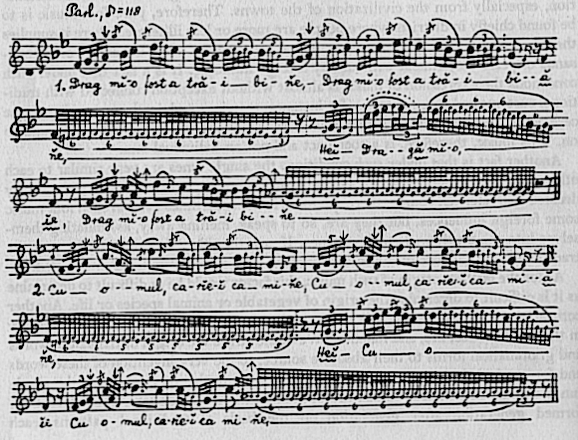
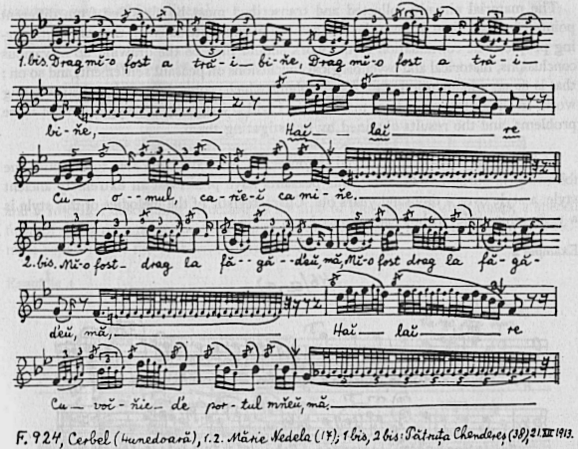
In each successive repetition of the tune, the performer varies the melismatic ornamentation of the basic melodic substructure. This process of transcription enabled the study and analysis of performance, which stimulated Bartók’s assimilation of a similar process into his own compositional idiom.
Paul Wilson demonstrates the use of the variation principle in Bartók’s Violin Sonatas. The first movement of Violin Sonata No. 1 (1921) uses sonata form, which is transformed by Bartók’s variational process. Wilson describes the rather unorthodox approach to the treatment of material in the development section:
Instead of a Beethovenian ‘working out’ of motifs, he makes the development a kind of meditative variation on the themes with some new material being added.144
Wilson points out that the movement creates formal design in three parts, which one might tabulate as A A′ A″.145 This movement illustrates the combination of two basic formations of Bartók’s musical thought: form and variation (the combination of Szabolcsi’s conscious and unconscious elements). This point can be demonstrated with an examination of the different statements of the main theme (Ex. 5.4). The theme is initially stated in the exposition (bar 3) and reappears in altered forms in the development and recapitulation sections (bars 123 and 187 respectively). In addition to variational strategies like modifications of pitch and rhythm, Bartok also changes other musical parameters such as register, tempo, and dynamic. The theme is repeated, but only in a form that is varied, and in this way Bartók was able to re-invigorate his music in a manner that he associated with the natural purity of expression in folk music.
Ex. 5.4: First Violin Sonata, movement 1. Treatment of main theme.
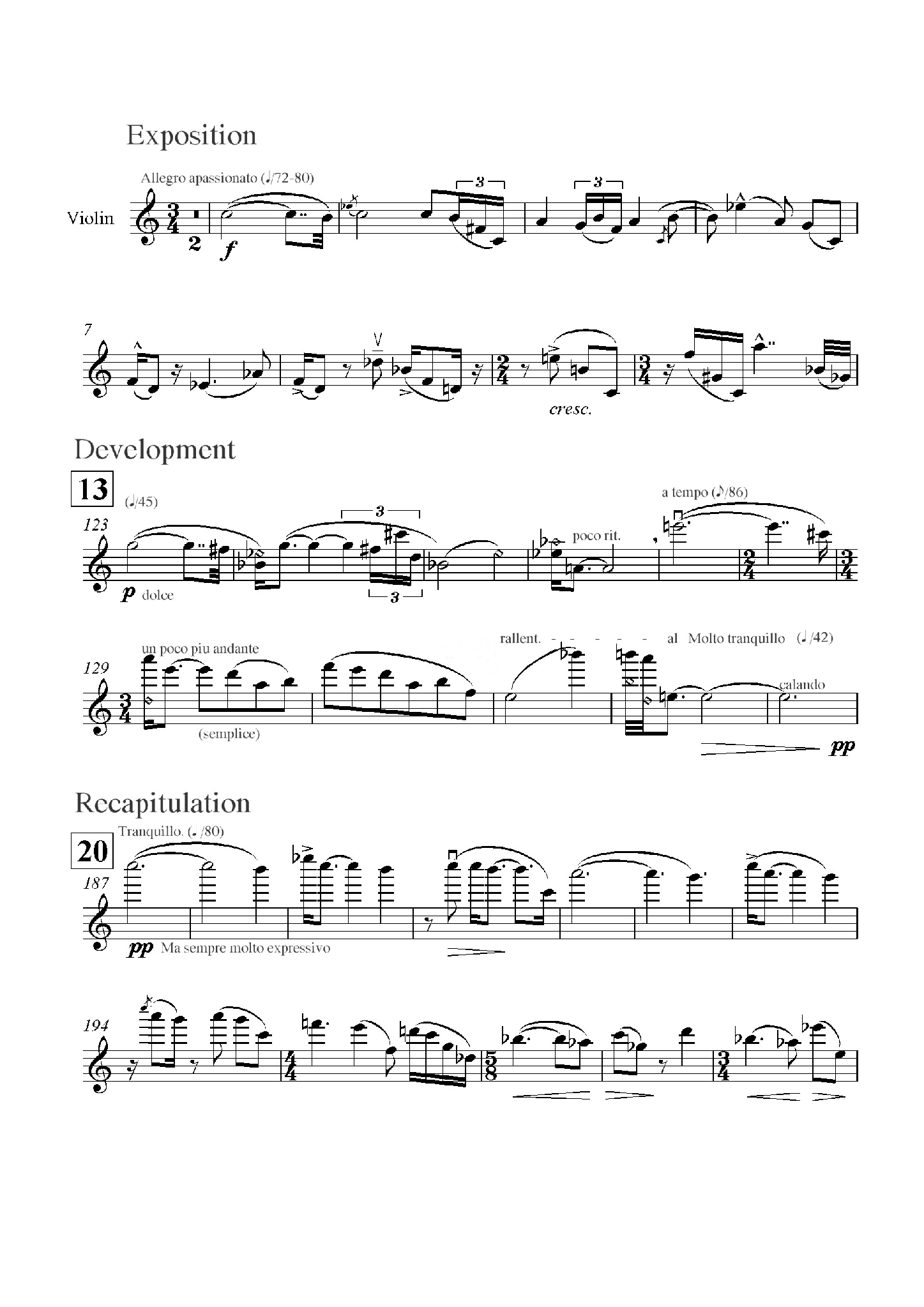
A similar manipulation of form occurs in the Violin Sonata No. 2 (1922). The first movement consists of an exposition and recapitulation of four themes. The layout of the work resembles sonata form without a development section.
In his discussion of the work, Wilson proposes the following formal analysis:
Ex. 5.5: Tabulation of the first movement of Violin Sonata No. 2.146
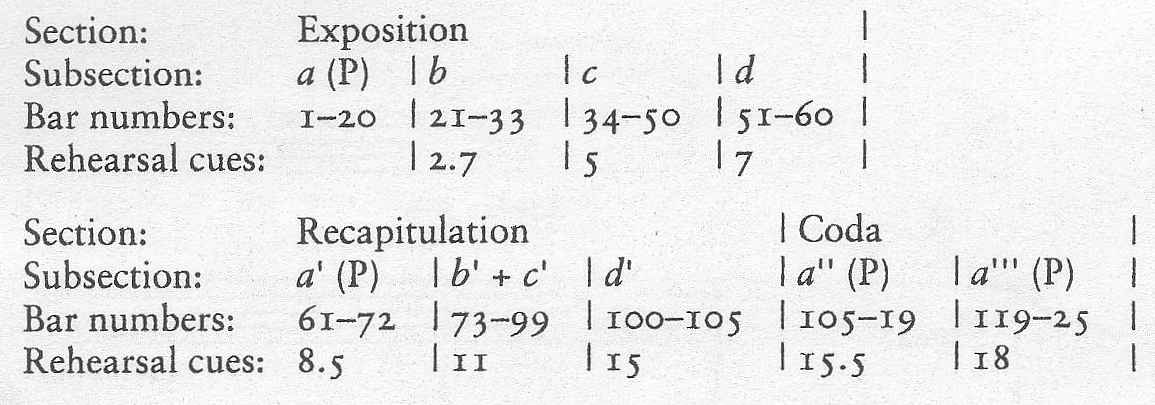
Bartók uses a process of variation to alter repetition of themes from exposition to recapitulation. The primary theme appears four times, and on each appearance it is varied according to a plan, which bears a strong resemblance to the variational procedure of folk music (Ex. 5.6). Peter Laki draws attention to the similarity of the main theme to the Romanian horă lungă, which has no fixed form and is improvisatory in character.147 The ornamental writing and rhythmical freedom of the melodic line implies a sense of improvisatory performance, which is allied to folk music.
Ex. 5.6: Violin Sonata 2, Movement 1. Variations of main theme.
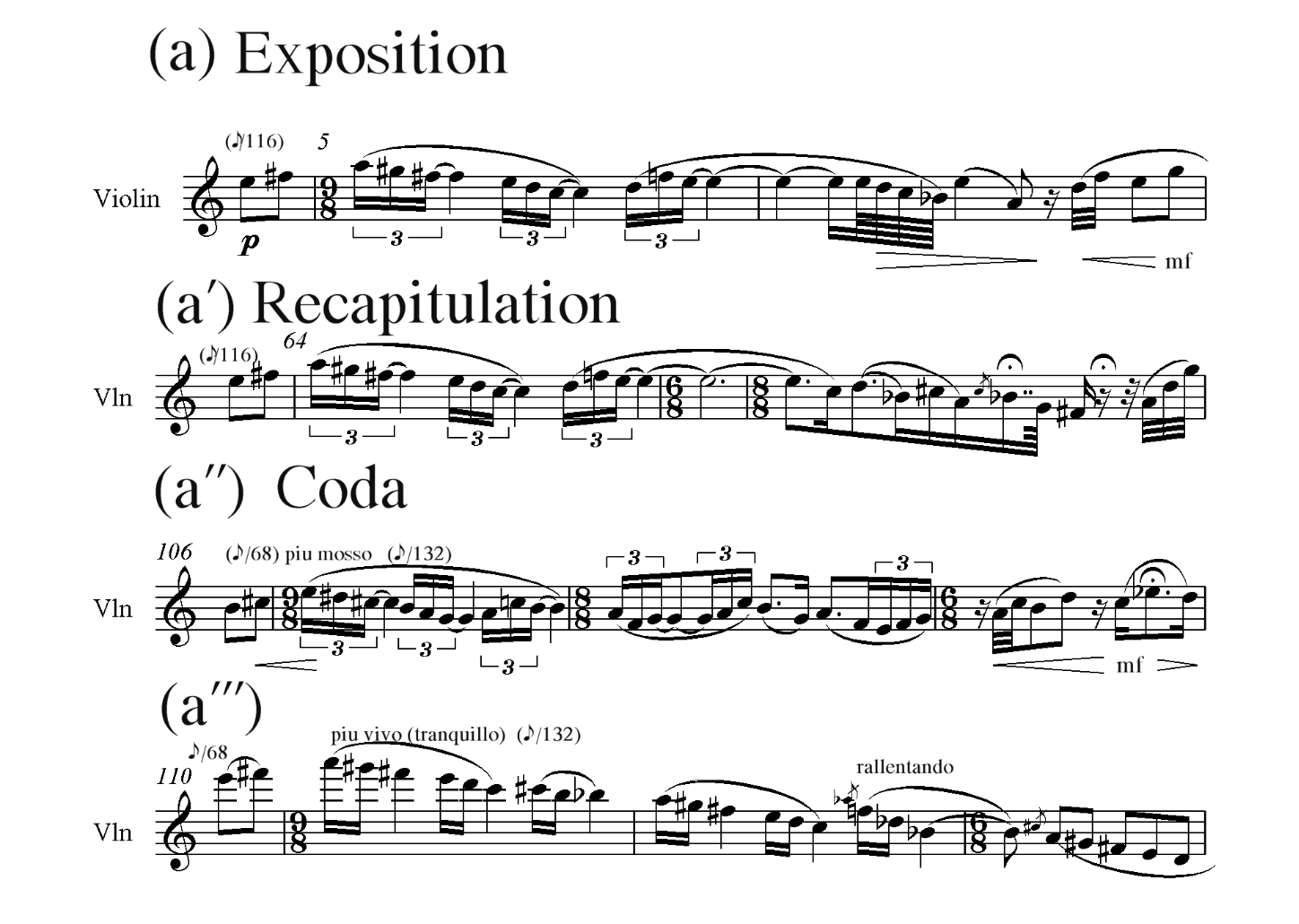
The variation principle can also be demonstrated in larger scale works like the String Quartet No. 4 (1928). This work is arranged using a symmetrical arch structure of five movements (ABCBA). The work’s five movements correspond to the character of the classical sonata form. Bartók uses an extensive variation process, which had become second nature to his music, within the movements and also between the various paired sections of the overall arch form. The central slow movement is the nucleus of the piece around which the other movements are symmetrically arranged. The fourth movement mirrors the second in free variation, and movements one and five share the same thematic material. It was in this manner that Bartók captured what he called the spirit or essence of folk music..
Rhythm
In the Fourth String Quartet (1928) Bartók used a variety of rhythmic approaches, which were influenced by different folk music models. In the third movement, he used a free ornamental line set in the cello, against the motionless chords of the other instruments (Ex. 5.7).
Ex. 5.7: Fourth String Quartet, Movement 3, bars 7-12.
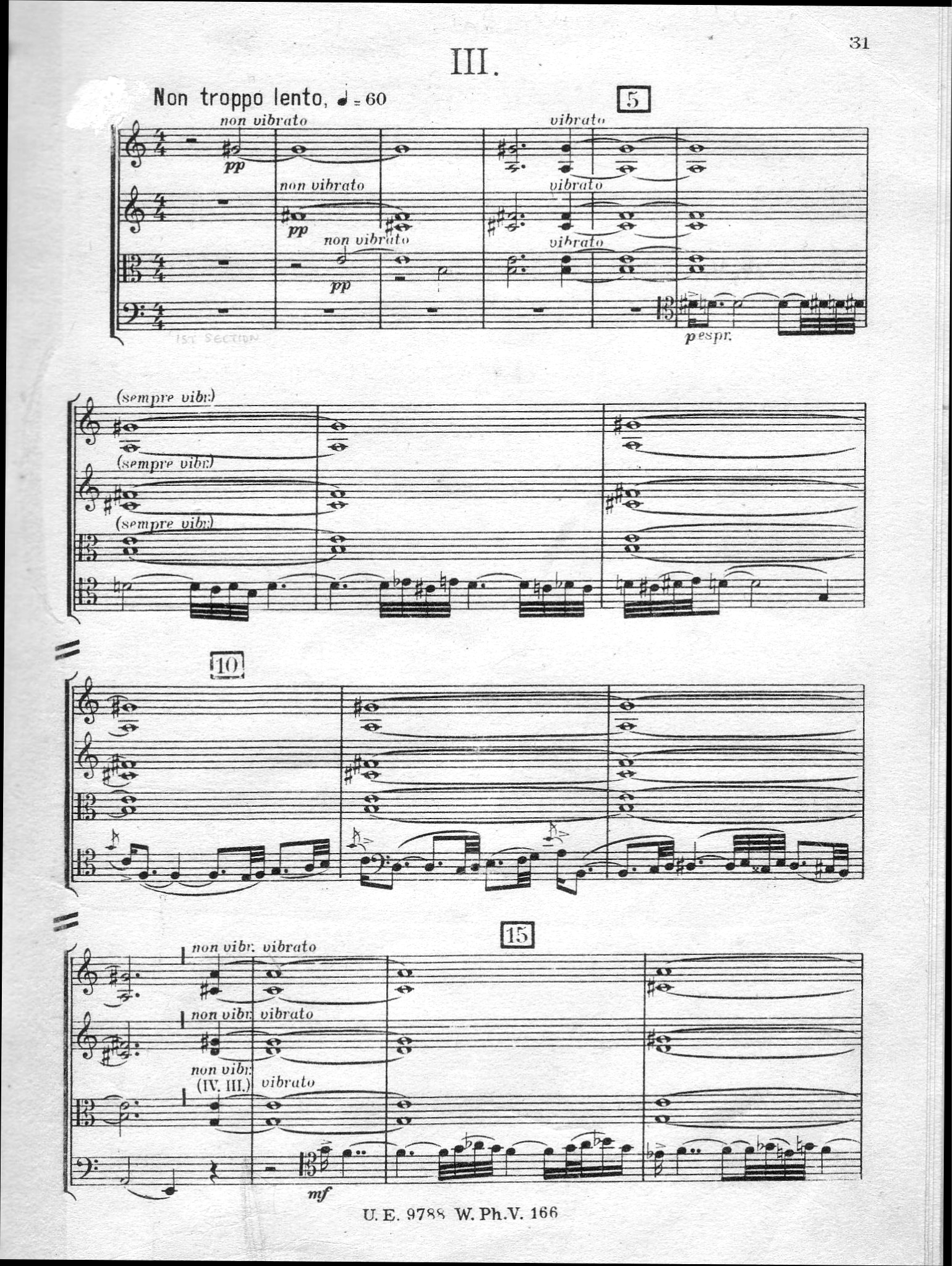
This melody demonstrates a rhythmical freedom that is achieved in many of Bartók’s works. Long notes, tied over the bar lines, are surrounded by small constellations of ornamental notes.
A probable influence was the rhythmically free “old style,” parlando rubato tunes of the Hungarian tradition. The following example demonstrates the indeterminate rhythmical values that can be found in this form of vocal rendition (Ex. 5.8)
Ex. 5.8: Example of old style folk tune148
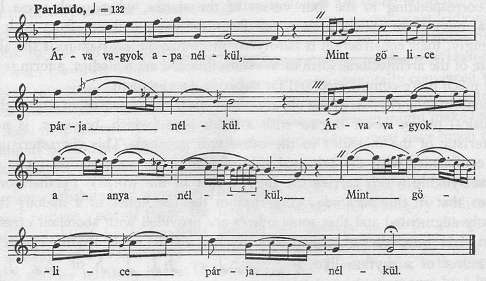
Variants of Romanian music, such as the horă lungă also made an impression on Bartók’s innate sense of irregular rhythm. Musicologists have shown many important comparisons between Bartok’s themes and the horă lungă. Bartok described the horă lungă and gave the following as an example (Ex. 95.9).
Its features are: strong instrumental character, very ornamented, and indeterminate content structure.149
Ex. 5.9: Section of a horă lungă melody transcribed by Bartók150
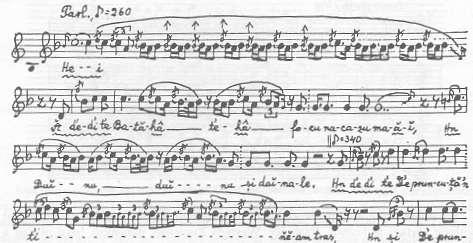
There is an obvious similarity between this type of melody and the third movement of the Fourth Quartet. At the point where the melodic line is transferred to the violin (bar 35), it adopts an improvised freedom similar to the feeling conveyed in the above transcription (Ex. 5.10).
Ex. 5.10: Fourth String Quartet, Movement 3, bars 35-40.
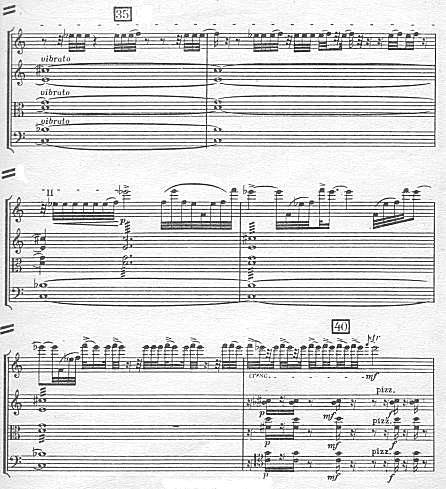
A different type of irregular rhythmic procedure can be found in the first and fifth movements of Bartók’s Fourth String Quartet. The rhythmic asymmetries contained in these movements share an affinity with Bartók’s experiences of Bulgarian rhythm. Timothy Rice describes how Bulgarian melody consists of “consistently repeated measures with two different durations in the relationship of 2 to 3.”151 The adding together of the rhythmical values of two and three create what is commonly termed “additive rhythm.” This is usually notated in meters of irregular groupings of sixteenth notes.
In his essay “The So-called Bulgarian Rhythm” (1938), Bartok described the rhythmic diversity of Bulgarian meters:
It appears that the most frequent Bulgarian rhythms are as follows: 5/16 (subdivided into 3+2 or 2+3); 7/16 (2+2+3 – the rhythm of the well known Ruchenitza dance); 8/16 (3+2+3); 9/16 (2+2+2+3) and about sixteen other less common rhythmic types, not counting rhythmically fixed formulas (that is different patterns in alteration).152
In the same essay he demonstrated this point using the following melody (Ex. 5.11)153
Ex. 5.11: Section of a Bulgarian Dance for Violin
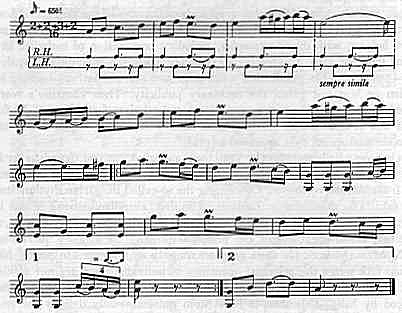
There is an obvious similarity with the irregular rhythmic groupings of the first movement of the Fourth Quartet. In the following example Bartók creates a complex rhythmical counterpoint using rhythmical asymmetry, achieved by beaming across bar lines, syncopated accents, and unequal metrical division within bars (Ex. 5.12).
Ex. 5. 12: Fourth Quartet, movement 1, bars 17-22.
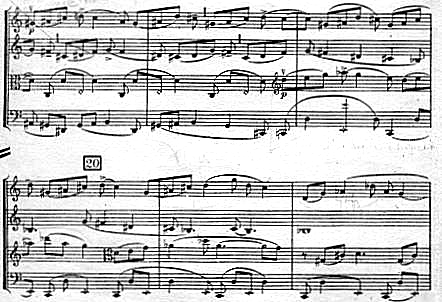
A similar effect is used in the fifth movement, where Bartók uses sforzandi accents to define rhythmical irregularity within a regular 2/4 meter (Ex. 5.13).
Ex. 5.13: Fourth Quartet, movement 5, bars 19-23.
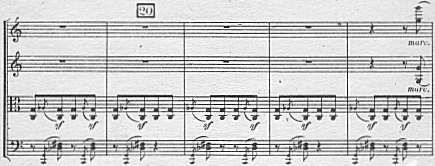
Janos Kárpáti points out that this movement has a form of a “loud robust dance with drumlike accompaniment,” which Bartók probably derived from his experiences of North African music in 1913.154
The most direct connection between Bartók’s music and Bulgarian rhythm can be found in his collection of didactic piano pieces, Mikrokosmos (1926-1939). This collection, which is a series of progressive piano pieces designed for piano teaching, explores many of the basic folk music influences that permeate Bartók’s work. The pieces numbered 113, 115 and 148-52 are all composed using Bulgarian rhythm. The following example is notated in one of the most popular forms of Bulgarian rhythm (2+2+3) (Ex. 5.14).
Ex. 5.14: Mikrokosmos No. 117, bars 1-6.
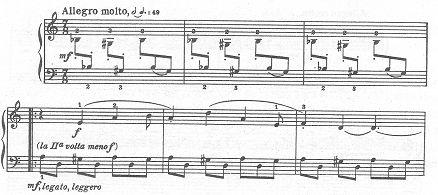
In addition to writing music in a rhythmically asymmetrical model of composition, Bartók also derived symmetrical patterns from folk music sources. Judit Frigyesi shows that the first and second subjects of the first movement of the Piano Concerto No.1 (1926) are derived from the repetitive kolomeika rhythm.155 These songs have a symmetrical structure with the characteristic rhythmical schema (𝅘𝅥𝅮𝅘𝅥𝅮𝅘𝅥𝅮𝅘𝅥𝅮 | 𝅘𝅥𝅮𝅘𝅥𝅮 𝅘𝅥 ). In this movement Bartók created a composition derived from one basic rhythmical idea, which Janos Kárpáti describes as a “proto-rhythm” that “serves as a basis from which a number of themes of the composition are set forth”.156 Frigyesi points out that a transformation of the main themes into an asymmetrical form of presentation occurs between the exposition and the recapitulation. Frigyesi describes how Bartók distorted his folk music model by twisting the structural parts out of their natural relation, displaying more concern for the energy of the folk model than its surface form.157 Rather than religiously following any one model, Bartók tends to adapt and transform a model according to his own expressive needs.
Modality
After a period of experimentation with abstract, atonal chromaticism in works such as: Miraculous Mandarin, Three Studies and the Violin Sonatas, Bartók concentrated on modality as a primary means of organising pitch structures. In his mature works he assimilated his knowledge of non-diatonic folk modes into his music. One of the most significant works to make this transition was the Cantata Profana (1930), which adopted non-diatonic modal material as the main source of modal material. Antokoletz points out that while interactions of diatonic, whole-tone and octatonic scale are common to many of Bartók’s works; it was the Cantata that was most successful in integrating non-diatonic scales into western art music.158 The Cantata was an ambitious project that achieved a synthesis of various folk music elements borrowed from the Transylvanian region of Romania. Bartók derived both the text and modal material for the Cantata from the Romanian colindă (Christmas songs).
The most prominent scale used in the Cantata Profana is the Romanian folk mode (better known as the acoustic scale) (Ex. 5.15). Griffiths points out that this scale, characterised by its augmented fourth and flattened seventh, had its debut as early as Bartók’s second Romanian Dance for piano (1909-10). In his study Romanian Folk Music Bartók lists a total of seven songs that use this scale (Ex. 5.16).
Ex. 5.15: Category no. 15 from Bartók’s table: Scale and range in the Colinda melodies.
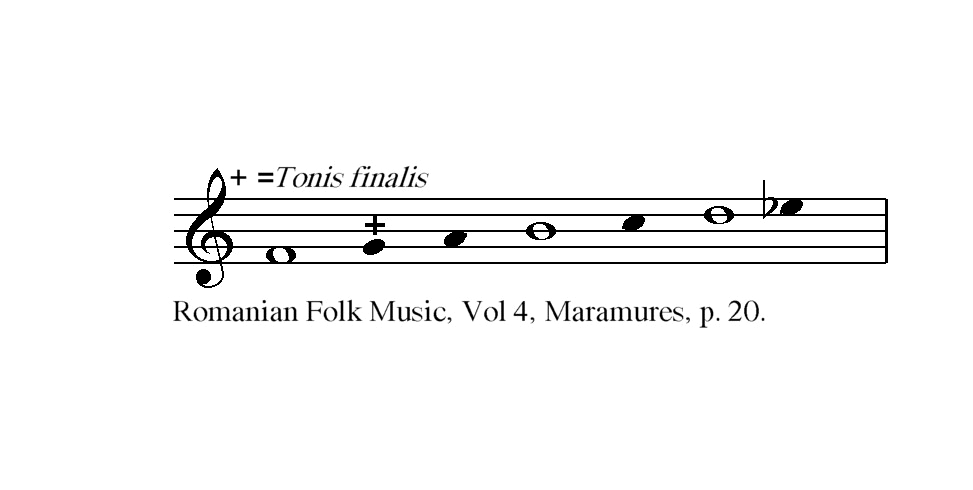
Ex. 5.16: Melody with Romanian folk mode, collected by Bartók in 1914.159
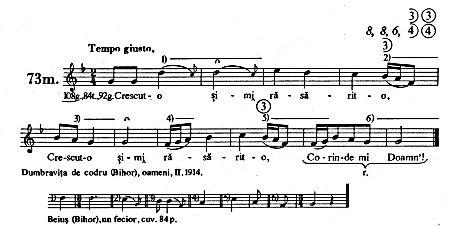
The Hungarian musicologist Ernő Lendvai demonstrated how this scale is based on the first sixteen harmonics of the harmonic series.160 It can also be shown that it consists of a bottom half Lydian scale and a top half Mixolydian scale. These two tetrachords are closely related to segments of the diatonic, whole-tone and octatonic pitch collections (Ex. 5.17).
Ex. 5.17: Acoustic Scale based on the notes of the overtone sequence.
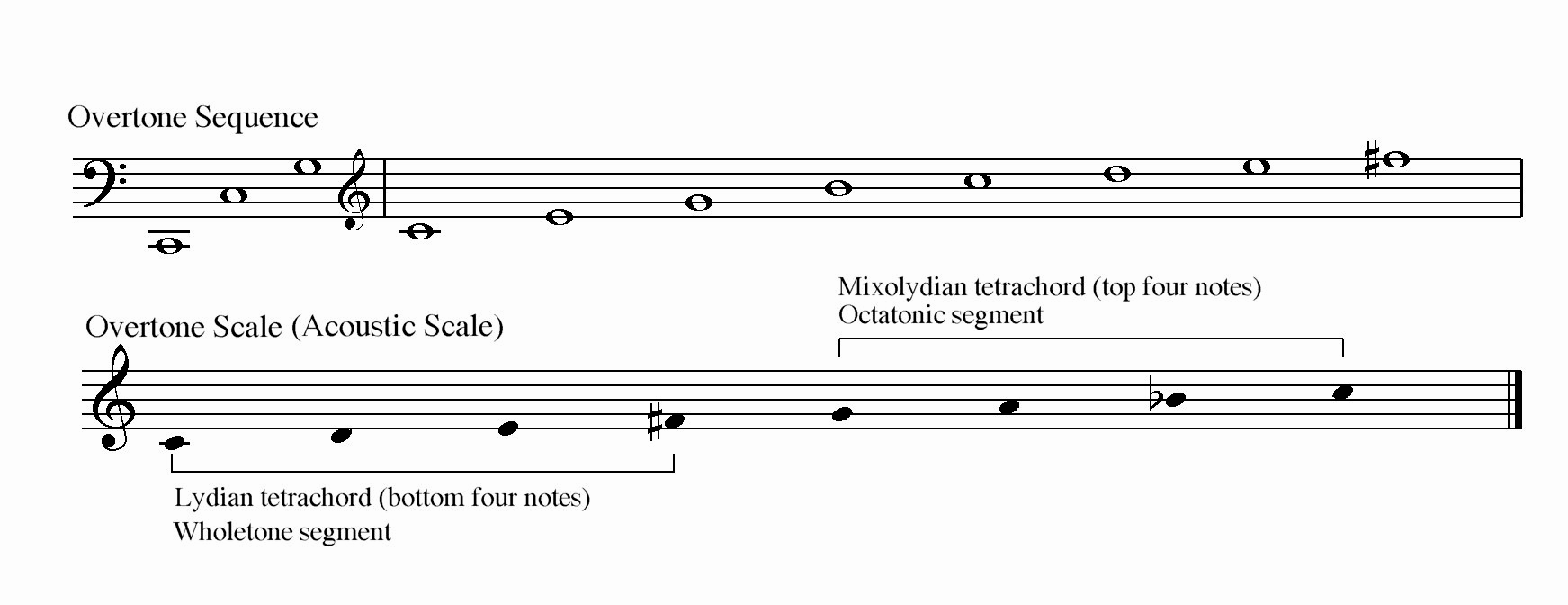
The closing tenor solo of the third movement of the Cantata Profana uses a complete Romanian scale (D-E-F♯-G♯-A-B-C-D) (Ex. 5.18), and the opening bars use a derived form (D-E-F-G-A𝄭-B𝄭-C-D) (Ex. 5.19).
EX. 5.18: Cantata Profana, Movement 3, bars 72-77.
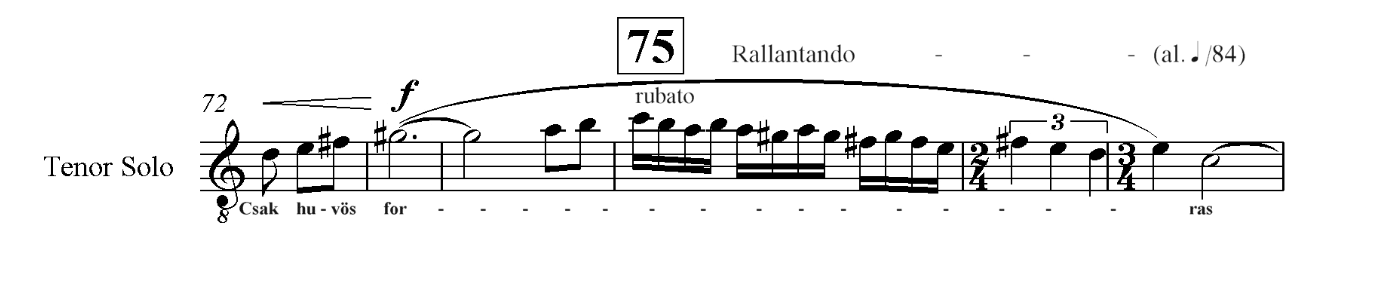
Ex. 5.19: Cantata Profana, Movement 1, bars 1-3.

Lendvai shows how these scales mirror each other in an inversional relationship (Ex. 5.20). He proposes a theory of a duality in Bartók works, involving two harmonic worlds, which compete with each other. The first scale of the Cantata belongs to the world of the golden section system, which revolves around the intervals expressed by the Fibonacci numbers 3:5:8. The final scale is derived from the acoustic system based on the overtone series. Lendvai further polarises these harmonic identities by characterising the golden section system as dissonant, and the acoustic system consonant.
An Equally deep secret of Bartók’s music (perhaps the most profound) is that the “closed” world of the golden section system is counterbalanced by an open sphere of the acoustic system.161
Ex. 5.20: Scales from the Cantata Profana
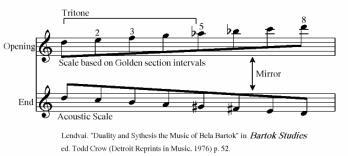
Antokoletz, on the other hand, shows the derivation of pitch materials from one modal family. Demonstrating the link between each of these two scale forms contradicts Lenvai’s theory, which tends to focus on the differentiated aspects of scale formations. Antokoletz shows that the first scale is derived from the second by a process of rotation and transposition, which is not unlike the manner in which church modes are created by a rotation of diatonic scales.162
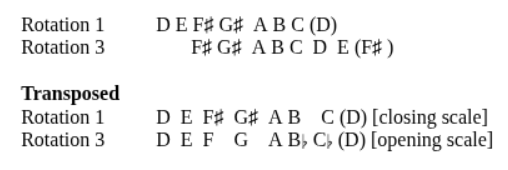
Antokoletz goes on to point out that Bartók achieves the transformation from one form of the scale to next by extending the basic modes to octatonic and whole-tone collections:
The approach is based on highly complex interactions between members of the larger family of non-diatonic folk modes from Easter Europe and symmetrical (whole-tone and octatonic) constructions of contemporary art music.163
It can be shown that the forms of non-diatonic scales, which already contain octatonic and whole tone segments are can be extended to complete statements of these collections.
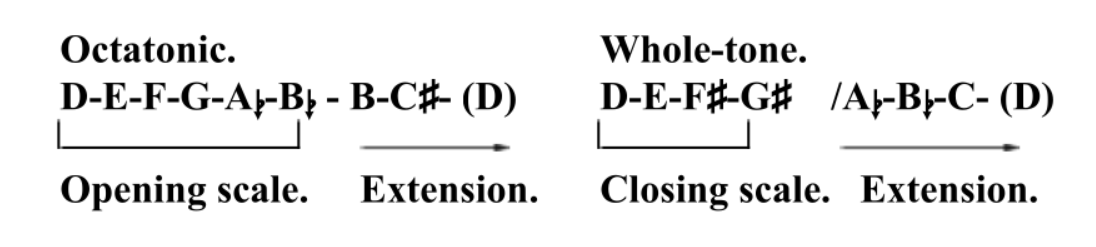
The above whole tone scale implies the transposition of the whole-tone tetrachord of the closing scale (A𝄭-B𝄭-C-D) to a tetrachord of the closing scale (D-E-F♯-G♯), illustrating the symmetrical transformation of one scale type to another. Antokoletz says that these extensions belong to the intermediary stage of overall modal transformation, which is linked to the musico-dramatic conception of the work.164
It can be shown that non-diatonic modes permeate much of Bartók’s mature music. Lendvai provides examples of the acoustic scale in works such as: Duke Bluebeard’s castle op. 11 (1911), The Wooden Prince (1914-16), String Quartet No. 4 (1928), Music for Strings Percussion and Celeste (1936), Sonata for two Pianos and Percussion (1937), Contrasts (1938), and Divertimento (1939).165 An examination of these works is beyond the remit of this paper, but on the whole it can be found that they all exhibit the tendencies of Bartók’s lifelong commitment to the synthesis of divergent modal material with the techniques of western art music.
Conclusion
The evolution of Bartók’s works is best understood as a complex of simultaneous folk music influences. It could be assumed that Bartók’s work has been so fully analysed that any future work would be inhibited. I have tried to point out in this paper that, for musicians, there are many promising routes for investigation, which reflect the need for analysis of national and historical folk music models.
From the very outset, Bartók’s youthful works were drawn into the arena of nationalism, as he adopted the prevailing musical clichés of the Hungarian tradition. A major watershed in his life was the discovery of peasant folk music, which had a decisive impact over his music, and presented him with a unified body of music, providing him with new, hitherto unexplored models for musical composition. Bartók embraced a concept of nationality that resided in the ancient cultural life of the peasant village and devoted a large part of his life to the collection and study of rural folk music.
The most significant achievement of this ethnomusicological work was the integration of elements into a personal musical style, which ran concurrently with his researches. This occurred in the form of arrangements of folk melodies, and in the construction of original music. Bartók’s ethnomusicological study was insolubly linked with the evolution of a musical process derived exclusively from nature:
Of course, many other (foreign) composers, who do not lean upon folk music, have met with similar results at about the same time – only in an intuitive or speculative way, which evidently is a procedure equally justifiable. The difference is that we created through Nature, for the peasant’s art is a phenomenon of Nature.166
In his early works Bartók relied increasingly on harmonic characteristics of folk melodies to provide a new means of musical expression, which also played a unifying role in his more abstract compositions. Bartók acknowledged the profound influence of folk music over his compositions. As early as 1923, he wrote the following notes about his well-known Dance Suite for piano:
Peasant music of all kinds of nationalities served as a model: Hungarian Romanian, Slovak and even Arab, and indeed, in places, even a cross between these kinds.167
This statement and others like it have opened a gateway for an investigation into the musical roots of Bartók music and has raised important questions as to the level of influence that was brought to bear on his original music.
In many of these works he fuses simultaneous musical influences, such as modal and pentatonic scales, melodic turns, rhythmic ideas, strophic structures, performance characteristics. This was achieved, not by transplantation of material, but by the exploration of material, extraction of its essence and assimilation into an organically unified whole. In a famous and often quoted letter to Octavian Beu in 1931, Bartók explained the pan-nationalist aspects of this integration of musical cultures:
My creative work, just because it arises from 3 sources (Hungarian, Romanian, Slovakian), might be understood as the embodiment of the very concept of integration so much emphasized in Hungary today…. .My own idea, however—of which I have been fully conscious as a composer—is a brotherhood of peoples in spite of all wars and conflicts. I try—to the best of my ability—to serve this idea in my music; therefore I don’t reject any influence, be it Slovakian, Romanian, Arabic or from any other source.168
It is my view that in the light of Bartók’s own extensive writings on the matter, a thorough understanding of Bartók’s lifelong interest in Eastern European folk is invaluable to a proper comprehension of his musical works.𝄭
Bibliography
Primary Sources
Bartók, Béla. Suchoff, Benjamin (ed.), Béla Bartók Essays (London: Faber and Faber, 1976; repr. Lincon, Nebr,. And London: University of Nebraska Press, 1992).
—. Demeny, Janos (ed.), Béla Bartók Letters, trans. Peter Balaban and Istvan Farkas, trans rev. Elizabeth West and Colin Mason (London: Faber and Faber, 1971).
—. Suchoff, Benjamin (ed.), The Hungarian Folk Song, trans. M D Calvocoressi, The New York Bartok Archive studies in musicology, no.13 (Albany: State University of New York Press, 1981).
—. Suchoff, Benjamin (ed.), Rumanian Folk Music, The New York Bartok Archive studies in musicology, no. 2-6 (The Hague: Martinus Nijhoff, 1975).
Secondary Sources
Antokoletz, Elliott, Béla Bartók: A Guide to Research, Garland reference library of the humanities, v.1926, 2nd ed. (New York; London: Garland Pub., 1997).
—. The Music of Béla Bartók: a study of Tonality and Progression in Twentieth-Century Music (Berkeley; London: University of California Press, 1984, Reprint 1989).
—. “The Musical Language of Bartók’s 14 Bagatelles for Piano” in Tempo, no.137 (1981), pp. 8–16.
—. “At last something truly new: Bagatelles” in BC, pp. 110-123.
—. “Modal Transformation and Musical Symbolism in Bartók’s Cantata Profana” in BP, pp. 61-76.
Bellman, Johnathan, “Verbunkos” in The New Grove Dictionary of Music and Musicians, ed. Stanley Sadie, 2nd ed., Vol. 26, (London: MacMillan Publishers Ltd, 2001). Pp. 425-426.
Chalmers, Kenneth, Béla Bartók (London: Phaidon, 1995).
Cooper, David, Bartok: Concerto for Orchestra, Cambridge Music Handbooks (Cambridge: Cambridge University Press, 1996).
—. “Bartók’s Orchestral Music and the Modern World” in CCB.
Erdely, Stephen, “Bartók and Folk Music” in CCB, pp.24-42.
Fischer, Victoria, “Piano Music: Teaching Pieces and Folk Song arrangements” in CCB, pp. 92-103.
Frigyesi, Judit, “Bela Bartók and the concept of nation and Volk in modern Hungary” in The Musical Quarterly, 72/2 (Summer 1994), pp. 225-87.
—. Béla Bartók and Turn-of-the-Century Budapest (Berkeley: Uni of California Press, 1998).
Gillies, Malcolm, “Bela Bartók” in The New Grove Dictionary of Music and Musicians, ed. Stanley Sadie, Vol. 2, (London: MacMillan Publishers Ltd, 2001), pp. 787-818.
Glatz, Ferenc, “Music, Political Thinking, National Ideas. The Social and Cultural Background to the Kossuth Symphony” in BKR, pp. 69-78.
Gluck, Mary, “The intellectual and Cultural Backgound of Bartók’s work” in BKR, pp. 9-23.
Griffiths, Paul, Bartók (London: J.M. Dent, 1984).
Kárpati, János, “The Piano Works of the War Years” in BC, pp. 146-161.
—. “Bartók in North Africa: A Unique Fieldwork and its Impact on His Music” in BP, pp. 171-184.
—. “The First Two Piano Concertos” in BC, pp. 498-514.
Kodály, Zoltan, Hungarian Folk Music (London: Barrie and Jenkins, 1971).
Kovács, Sándor, “The Ethnomusicologist” in BC, pp. 51-63.
Lackó, Miklós, “The Intellectual Environment of Bartók and Kodály, with Special
Regard to the Period Between the two World Wars” in BKR, pp. 25-44.
Laki, Peter, “Violin Works and the Viola Concerto” in CCB, pp. 133-150.
Lampert, Vera, “Works for Solo Voice and Piano” in BC, pp. 387-412.
Lendvai, Erno, Béla Bartók: An Analysis of his Music (London: Kahn & Averill, 1971).
—. “Duality and Synthesis in the Music of Béla Bartók” in BS, pp. 39-75.
Rice, Timothy, “Béla Bartók and Bulgarian Rhythm” in BP, pp. 196-210.
Sárosi, Bálint, Gypsy Music (Budapest: Corvina Press, 1978).
—. Folk Music: Hungarian Musical Idiom (Budapest: Corvina Press, 1986).
Schoenberg, Arnold, “Folkloristic Symphonies” in Style and Idea, ed. Leonard Stein (London: Faber and Faber, 1975). Pp. 161-166.
Somfai, Lásló, Béla Bartók: Composition, Concepts and Autograph Sources (Berkeley; Los Angeles; London: University of California Press, 1996).
—. Béla Bartók: The Complete Edition (Budapest: Hungaroton LPX 1299).
Stevens, Halsey, The Life and Music of Béla Bartók (Oxford: Oxford University Press, 1975).
Suchoff, Benjamin. “Bartók’s Odyssey in Slovak Folk Music” in BP, pp. 15-27.
—. “Fusion of National Style: Piano literature, 1908-11” in BC, pp. 124-145.
Szabolcsi, Bence, “Man and Nature in Bartók World” in BS, pp. 63-75.
—. “Bartók’s Principals of Composition” in BS, pp. 19-21.
Willson, Rachel Beckles, “Vocal Music: Inspiration and Ideology” in CCB, pp. 78-91.
Wilson, Paul, The Music of Béla Bartók, (New haven, Conn.; London: Yale University Press, 1992).
—. “Approaching Atonality: Studies and Improvisations” in BC, pp. 162-172.
—.”Violin Sonatas” in BC, pp. 243-256.
Yeomans, David, “Background and analysis of Bartók’s Romanian Christmas Carols for Piano (1915)” in BP, pp. 185-195.
Symposium
Antokoletz, Elliot; Victoria Fischer; Benjamin Suchoff (eds.), Bartók Perspectives: Man, Composer, and Ethnomusicologist (Oxford: Oxford University Press, 2000).
Bayley, Amanda, (ed.) The Cambridge Companion to Bartók (Cambridge: Cambridge University Press, 2001).
Crow, Todd (ed.), Bartók Studies (Detroit: Detroit Information Coordinators, 1976).
Gillies, Malcolm (ed.), The Bartok Companion (London: Faber and Faber, 1993).
Rankí, György (ed.) Bartók and Kodály Revisited (Budapest: Académiai Kiadó, 1987).
List of Cited Compositions by Béla Bartók
| Title | Date of composition |
|---|---|
| Kossuth, for orchestra | 1903 |
| Rhapsody, Op. 1, for piano solo | 1904 |
| Scherzo, Op. 2, for piano and orchestra | 1904 |
| Hungarian Folksongs, for voice and piano | 1906–1907 |
| Eight Hungarian Folksongs, for voice and piano | 1907 & 1917 |
| Three Hungarian Folksongs from Csík, for piano | 1907 |
| Fourteen Bagatelles, Op. 6, for piano | 1908 |
| Ten Easy Pieces, for piano | 1908 |
| For Children, for piano | 1908-1910 |
| Seven Sketches, Op. 9b, for piano | 1908-1910 |
| Romanian Christmas Songs, for piano | 1915 |
| Romanian Folk Dances, for piano | 1915 |
| The Three Studies, Op. 18, for piano | 1918 |
| Improvisations on Hungarian peasant songs, for piano, Op. 20 | 1920 |
| Sonata for Violin and Piano no. 1, Op. 21 | 1921 |
| Sonata for Violin and Piano no. 2 | 1922 |
| Village Scenes for Voice and Piano | 1924 |
| String Quartet, no. 4 | 1928 |
| Twenty Folksongs, for Voice and Piano | 1929 |
| Mikrokosmos, 153 pieces for piano | 1926-1939 |
| Cantata Profana, for tenor, baritone, double chorus and orchestra | 1930 |
List of Abbreviations
Antokoletz/1984 Elliot Antokoletz, The Music of Béla Bartók: A Study in Tonality and Progression in Twentieth Century Music (Berkeley: University of California Press, 1984).
BB Béla Bartók Thematic Catalogue number.
BC The Bartók Companion, ed. Malcolm Gillies
(London: Faber and Faber Ltd, 1993).
BBE Béla Bartók Essays, ed. Benjamin Suchoff.
(London: Faber and Faber 1976).
BBL Béla Bartók Letters, ed. Janos Demeny
(London: Faber and Faber Ltd, 1971).
BKR Bartok and Kodaly Revisited, ed. György Ránki.
(Budapest: Akadémiai Kiadó, 1987).
BP Bartók Perspectives: Man, Composer, and Ethnomusicologist, eds. Elliott Antokoletz; Victoria Fischer; Benjamin Suchoff (Oxford: Oxford University Press, 2000).
BS Bartók Studies, ed. Todd Crow
(Detroit: Detroit Information Coordinators, 1976).
CCB The Cambridge Companion to Bartok, ed. Amanda Bayley
(Cambridge: Cambridge University Press, 2001).
HFM Hungarian Folk Music, ed. Benjamin Suchoff
(Albany: State University of New York Press, 1981).
RFM Romanian Folk Music, ed. Benjamin Suchoff
(The Hague: Martinus Nijhoff, 1975).
Stevens/1975 Halsey Stevens, The Life and Music of Béla Bartók,
(Oxford: Oxford University Press, 1953, revised edition 1964, reprint 1975).
Notes
- Judit Frigyesi. “Béla Bartók and the Concept of Nation and Volk in Modern Hungary” in Musical Quarterly, 72/2 (Summer 1994), p. 259. ↩
- Ibid. p. 263. ↩
- Mary Gluck “The Intellectual and Cultural Background of Bartók’s work” in BKR, p. 10. ↩
- Statistics taken from Miklós Lackó. “The Intellectual Environment of Bartók and Kodály, With Special Regard to the Period Between the Two World Wars” in BKR, p. 26. ↩
- Ibid. ↩
- Ibid. p. 27. ↩
- Frigyesi, 1994, p. 260. ↩
- Stephen Erdely “Bartók and Folk Music” in CCB (2001) p. 26. ↩
- Detailed descriptions of the use of Verbunkos as recruiting music can be found in Bálint Sárosi. Gipsy Music (Budapest: Corvina Press, 1978), pp. 86-89. ↩
- Ibid. p. 85. ↩
- Ibid. ↩
- Johnathan Bellman. “Verbunkos” in The New Grove Dictionary of Music and Musicians, Second Edition, Vol. 26, pp. 425-426. (London: MacMillan, 2001). ↩
- Kodály, Zoltán. Hungarian Folk Music (London : Barrie and Jenkins, 1971), p. 7. ↩
- Sárosi, 1978, p. 90. ↩
- Stephen Erdely, 2001, p. 25. ↩
- Ibid. p. 26. ↩
- Bálint Sárosi. Folk Music: Hungarian Musical Idiom (Budapest: Corvina, 1986), p. 57. ↩
- Reproduced from Sárosi, 1986, p. 58. ↩
- Kodály, 1971, p. 6. ↩
- Sárosi, 1978, p. 115. ↩
- Examples 1.3 & 1.4 are Reproduced from Sárosi, 1978, pp. 115-118. ↩
- Bartók. “Autobiography” (1921) in BBE, p. 409. ↩
- The programme of Kossuth is explained in Bartók’s essay “Kossuth Symphonic poem” in BBE, pp. 399-403. ↩
- Bartók. BBL, p. 50. ↩
- Ferenc Glatz. “Music, Political Thinking, National Ideas. The Social and Cultural Background to the Kossuth Symphony” in BKR, p. 77. ↩
- Gluck, 1987, p. 10. ↩
- Glatz, 1987, p. 77. ↩
- Bartók. HFS, No. 313. (“Piros alma” – The Red Apple) ↩
- See Suchoff, Benjamin. “Bartok’s Odyssey in Slovak Folk Music” in BP, p. 16. ↩
- Steven/1975, p. 22. ↩
- Kovács, Sándor. “Ethnomusicologist” in BC, (1993) p.51. ↩
- 26th December, 1904. Quoted in Griffiths, Paul. Bartok ( London: J.M. Dent, 1984), p. 17. ↩
- Bartók. “Autobiography” in BBE, p. 409. ↩
- , Kovács, 1993, p. 51. ↩
- Bartók. “Hungarian Folk Music” (1921), BBE, p.59. ↩
- Bartók. “Gipsy Music or Hungarian Music” (1931) in BBE, p. 206. ↩
- Bartók. “What us Folk Music?” (1931), BBE, p.6. ↩
- Bartók. “Why and How do we Collect Folk Music” (1936), BBE, p.10 ↩
- Bartók, HFS, p.3. ↩
- Bartók. “Hungarian Peasant Music” (1933), BBE, p.81. ↩
- Bartók. “Hungarian Folk Music” (1921), BBE, p. 72. ↩
- Bartók, HFS, pp. 2-3. ↩
- Stevens/1975. p.25. ↩
- Bartók. “What is Folk Music” (1931), BBE, p. 6. ↩
- Quoted in Bence Szalbocsi. “Man and Nature in Bartok’s world” in BS, p. 67. ↩
- Stevens/1975, p. 36. ↩
- Bartók and Kodály. The Hungarian Folksong (Reprint of the original manuscript with commentaries by Denijs Dille (London: Boosey and Hawkes, 1970) ↩
- Reproduced from Erdely,2001, p. 30. ↩
- Erdely, 2001, p. 28. ↩
- Bartók. BBL, p. 69. ↩
- Bartók. “The Folk Songs of Hungary” (1928), BBE. p. 332. ↩
- Bartok. BBL. p. 74-5. ↩
- Quoted in Erdely, 2001, p. 30. ↩
- Erdely, 2001, p. 30. ↩
- Bartók. “Hungarian Peasant Music” (1933) in BBE, p. 91. ↩
- Suchoff, Benjamin. “Bartók’s Odyssey in Slovak Folk Music” in BP, pp. 17-18. ↩
- Reproduced from Erdely, 2001, p 33. This detailed account of Bartók’s field trips has been compiled from Béla Bartók Jr.’s account of his father’s life and János Demény’s biographical study. ↩
- Bartók. “Romanian Folk Music” in BBE, p. 119-20. ↩
- Reproduce from Yeomans, David “Background and analysis of Bartók’s Romanian Christmas Carols for Piano (1915)” in BP, p. 186. ↩
- Bartók. “Why and How we Collect Folk Music? ” (1931) in BBE, p. 11. ↩
- Ibid., p.12. ↩
- Stephen Erdely. “Complimentary Aspects of Bartók’s and Kodály’s folk song researches” in BKR, p. 83. ↩
- Kovács, 1993, p. 57. ↩
- Bartok, “Hungarian Peasant Music” (1920) BBE, p. 305. ↩
- Bartók, “Hungarian Folk Music” (1933) BBE, p. 74. ↩
- Bartók “Hungarian Peasant Music” (1920) in BBE p, 305-306. ↩
- Victoria Fischer. “Piano music: teaching pieces and folksong arrangements” in CCB. 100. ↩
- Bartók. “The Relation Between Contemporary Hungarian Art Music and Folk Music” (1941) in BBE, p. 351. ↩
- Ibid., p. 352. ↩
- Griffiths, 1984, p. 47. ↩
- Bartok. “Autobiography” (1921) in BBE, p. 410. ↩
- Bartók. “The Influence of Peasant Music on Modern Music” (1931) in BBE, p. 342. ↩
- Bartók. “The Relation Between Contemporary Hungarian Art Music and Folk Music” (1941) in BBE, p. 353. ↩
- Bartók. “The Folk Songs of Hungary” (1928) in BBE, p. 334. ↩
- Ibid. ↩
- Bartók. “The Folk Songs of Hungary” (1928), p. 388. ↩
- Bartók. “Harvard Lectures (1943) in BBE, p.367. ↩
- Ibid. ↩
- Ibid., p.376. ↩
- Bartók and Kodály. The Hungarian Folksong (Reprint of the original manuscript with commentaries by Denijs Dille (London: Boosey and Hawkes, 1970). ↩
- Vera Lampert. “Works for Solo voice with Piano” in BC (1993), p. 392. ↩
- Elliot Antokoletz/1984, p. 26. ↩
- Griffiths, 1984, p. 20. ↩
- Vera Lampert, 1993, p.395. ↩
- Antokoletz/1984, ch. 2. ↩
- Antokoletz/1984, p. 33. ↩
- Ibid. p. 34. ↩
- Bartok. HFM, pp. 17-18. ↩
- Antokoletz/1984, p. 35 ↩
- Ibid., p. 42. ↩
- Bartok. “The Folk Songs of Hungary” (1928) in BBE, p. 336. ↩
- Antokoletz/1984, p. 41. ↩
- Ibid., p. 42. ↩
- Lampert, 1993, p.395. ↩
- Antokoletz/1984, p. 29. ↩
- Suchoff. “Fusion of National styles: Piano Literature, 1908-11” in BC (1993), p. 130. ↩
- János Kárpáti. “The piano Works of the War Years” in BBC, p. 151. ↩
- Ibid., p. 151-152. ↩
- Antokoletz/1984, p.1. ↩
- Bartók. “Harvard Lectures” (1943) in BBE, p.370. ↩
- Ibid., p. 370. ↩
- Ibid., p. 362. ↩
- Bartók. “Autobiography” (1921) in BBE, p. 410. ↩
- Bartók. “Introduction to Béla Bartók Masterpieces for the Piano” (1945) in BBE, p. 432. ↩
- Ibid., p. 432. ↩
- Quoted in Lázlo Somfai. Béla Bartók: Composition, Concepts and Autograph Sources (Berkeley: University of California Press, 1996), p. 12. ↩
- Stevens/1975, pp. 41-42. ↩
- Antokoletz. “‘At last something truely new’: Bagatelles” in BBC, p. 110. ↩
- Lásló Somfai, Béla Bartók: The Complete Edition (Budapest: Hungaroton LPX 1299), 8. ↩
- Fischer. “Bartók’s Fourteen Bagatelles op..6, for piano” in BP, p. 273. ↩
- Bartók. “Introduction to Béla Bartók Masterpieces for the Piano” (1945) in BBE, p. 433. ↩
- Ibid. ↩
- Bartók. “Harvard Lectures” (1943) in BBE, p.365. ↩
- Antokoletz/1984, p.52. ↩
- Ibid, pp 52-52. ↩
- Bejamin Suchoff, 1993, p. 140. ↩
- Bartók. “Introduction to Béla Bartók Masterpieces for the Piano” (1945) in BBE, p. 433. ↩
- Antokoletz,/1984, p. 78. ↩
- Ibid, p.83. ↩
- Ibid., pp. 69-70. ↩
- Label applied by Antokoletz. ↩
- Ibid., p.204. ↩
- Bartok, “The Folk Songs of Hungary” (1928) in BBE, p. 336. ↩
- Malcolm Gillies. “Béla Bartók” in New Grove Dictionary of Music and Musicians, ed. Stanley Sadie, 2nd ed. Vol. 2, p. 796. ↩
- Bartók, “The problem of the Modern Music” (1920) in BBE. p. 456. ↩
- Wilson, “Approaching Atonality: Studies and Improvisations” in BC (1993), p. 162. ↩
- Bartók, “Harvard Lectures” (1943) in BBE. p. 375. ↩
- Griffiths, 1984, p. 26. ↩
- Ibid., p. 341-342. ↩
- Schoenberg, “Folkloristic Symphonies” (1947) in Style and Idea, ed. Leonard Stein, (London: Faber and Faber, 1975), p. 183 ↩
- Wilson,1993, p. 166-71. ↩
- Ibid., p.168. ↩
- Lampert, “Works for Solo Voice and Piano” in BC, p. 398. ↩
- Ibid. pp 388-99. ↩
- Ibid. p. 401. ↩
- Willson, “Vocal Music: Inspiration and Ideology” in CCB, p. 84. ↩
- Griffiths, 1984, p. 30. ↩
- Szabolcsi. “Bartok’s Principals of Composition” in BS, p. 19. ↩
- Ibid. pp. 19-20. ↩
- Griffiths, 1984, p. 30. ↩
- Ibid. p. 30. ↩
- Benjamin Suchoff, 1993, pp. 125-126. ↩
- Bartók. “The Relation Between Contemporary Hungarian Art Music and Folk Music” (1941) in BBE, p. 349. ↩
- Paul Wilson. “Violin Sonatas” in BC, p.246. ↩
- Ibid. p.247. ↩
- Ibid. p.252. ↩
- Peter Laki. “Violin Works and the Viola Concerto” in CCB, p. 137. The folk source of this motto was identified in a lecture given by Lázló Somfai in 1977. ↩
- Bartok. “Hungarian Folk Music” (1921) in BBE, p. 62. ↩
- Bartók. “Romanian Folk Music” (1938) in BBE, p. 155. ↩
- Example 8 in “Some Problems of Folk Music Research in East Europe” (1940) in BBE, p. 182. ↩
- Timothy Rice. “Béla Bartók and Bulgarian Rhythm” in BP, p. 196. ↩
- Bartók. “The So-Called Bulgarian Rhythm” (1938) in BBE, p. 44. ↩
- Ibid. ↩
- Kárpáti. “Bartók in North Africa” in BP, pp. 181-82. ↩
- Judit Frigyesi. Béla Bartók and Turn-of-the-Century Budapest (Berkeley: Uni. Of California Press, 1998) p. 123. ↩
- Janos Kárpáti. “The first two piano Concertos” in BC, p. 502. ↩
- Ibid. p. 128. ↩
- Antokoletz, 1984, p. 205-206. ↩
- Bartók. RFM, p. 121. ↩
- Ernő Lendvai. Béla Bartok: An Analysis of his Music (London: Kahn & Averill, 1971) p. 67. ↩
- Ernő Lendvai. “Duality and Synthesis in the Music of Béla Bartók” in Bartók Studies. Ed. Todd Crow (Detroit Reprints in Music, 1976) p. 52. ↩
- Antokoletz. “Modal Transformation and Musical Symbolism in Bartók’s Cantata Profana” in BP, p. 62. ↩
- Ibid. p. 74. ↩
- Ibid. p.66-67. ↩
- Ernő Lendvai. “Duality and Synthesis in the Music of Béla Bartók” BS. in pp 67-70. ↩
- Bartók. “The Folk Songs of Hungary” (1928) in BBE, p. 338. ↩
- Quoted in János Kárpati. “Béla Bartók: The possibility of musical integration in the Danube Basin” in BKR, p. 157. ↩
- Bartók. Letter dated January 10th, 1931 in BBL, p. 201. ↩