“The rule is: jam tomorrow, and jam yesterday, but never jam today.” Alice in Wonderland – Lewis Carroll
I wrote this back in 2008, but it seems worth raising the topic again, especially now that AI has hijacked the rule of three and is using it everywhere, often in the most inane way. That threatens to ruin the impact of a very powerful rhetorical device.
Why three?
Have you ever wondered why three is better than two or four? Well, we can observe some basic facts: three is the sum of the first three whole numbers, a triangle has three sides, and it is from the first three numbers that all other numbers are derived. A primordial triangle!
Around us, we can easily see how the number three pervades human culture. A good example of this mysterious power of three can be found in children’s stories such as Goldilocks and the Three Bears, Three Billy Goats Gruff and The Three Little Pigs. Things often happen in threes in fairy tales.
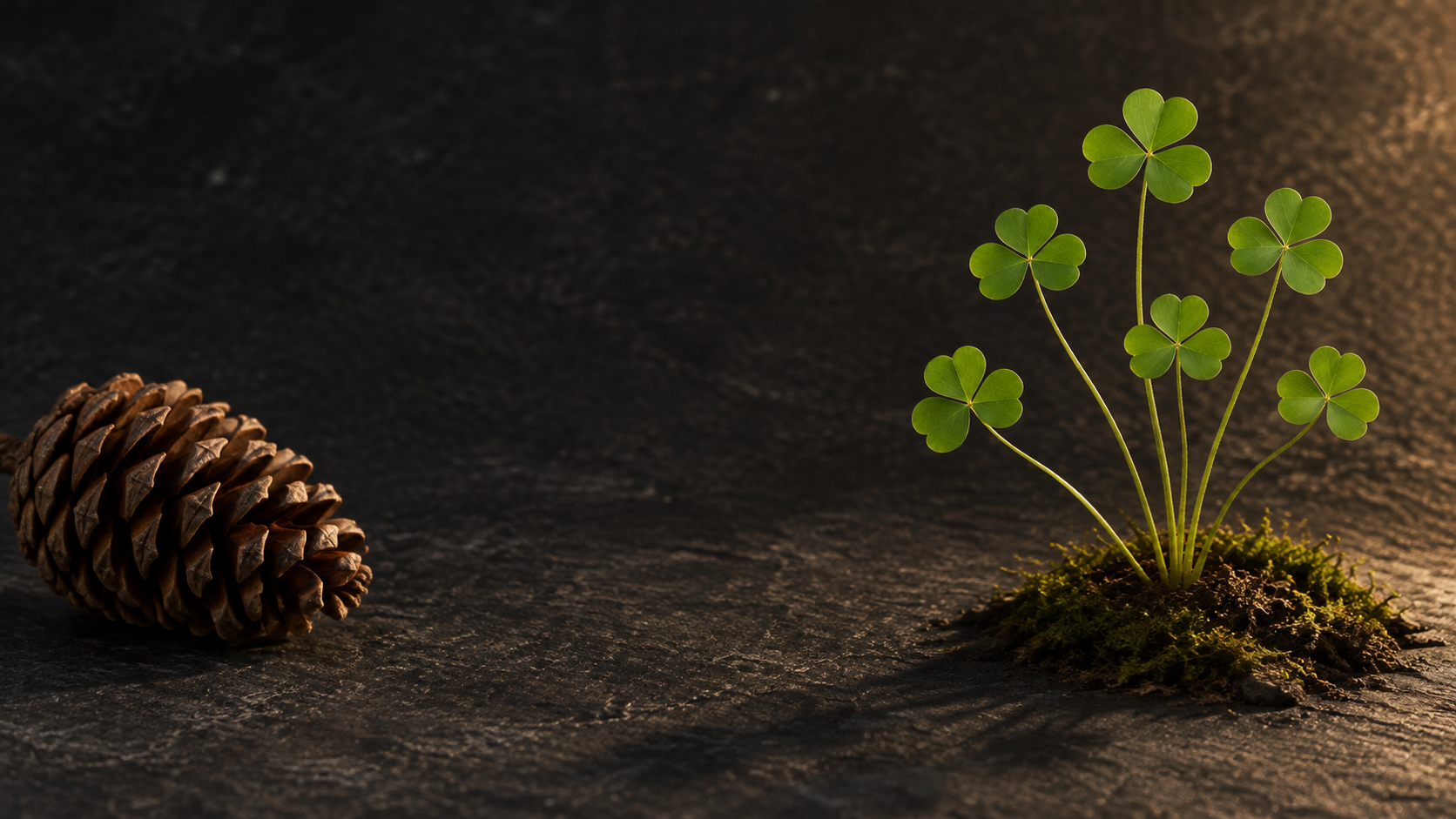
The number three obviously has pagan magical roots dating back long before Christianity, but it also pervades religion. The patron saint of Ireland, Saint Patrick, was said to have converted the Irish using the three-leaved clover to illustrate the idea of the Holy Trinity: “Father, Son and Holy Spirit”, in its simplistic, natural perfection.
The holy number three often crops up in the biblical story, such as the three wise men bearing three gifts, the three steps to salvation, and Jesus arising from the dead on the third day. If you hear three knocks at the door, then it is probably your Freemason friends coming round, because the number three is one of the major themes of Freemasonry.
We are encouraged to believe that the third attempt at something could be the lucky one. Three can also stand for your boredom threshold. For example, the “three-click rule” of the internet states that, if an internet user cannot find what he or she is looking for in three clicks, he or she will get annoyed and leave the site.
Yet another theory suggests that, if somebody can be convinced to answer the first two questions in a sequence of three with a “yes”, then they will automatically answer the third with a resounding “yes” too. Third time lucky for a salesman!
Three as form
It is no wonder, then, that the number three is one of the most fundamental units of form. We get triads, triptychs and trilogies. Most forms of human endeavour have a structure with a beginning, middle and end.
In classical music, ternary form is very dominant, and classical sonata form has a typical three-section structure: exposition, development and recapitulation. Think of presentations and public speaking. In addition to the three main elements of introduction, main body and conclusion, we have internal divisions into powerful sets of three.
Take, for example, Barack Obama’s inaugural speech:
“Humbled by the task before us,
grateful for the trust you have bestowed,
mindful of the sacrifices borne by our ancestors.”
“We must pick ourselves up,
dust ourselves off,
and begin again the work of remaking America.”
Other famous quotes using threes are in abundance: “Friends, Romans, and Countrymen” (William Shakespeare, Julius Caesar), “Government of the people, by the people, for the people” (Abraham Lincoln, Gettysburg Address), and “This is not the end. It is not even the beginning of the end. But it is, perhaps, the end of the beginning” (Winston Churchill).
The rule of thirds
Why is the so-called “rule of three” so effective? Visually, three objects can be quite powerful, especially when placed in a dynamic triangle shape. The distances must not be exactly equal, giving each object a unique place and a dynamic feeling.
You might notice a linear grid on your digital camera display, which represents the rule of thirds in photography. This is a simplification of the concept of the golden section, which is invaluable to aspiring photographers. The idea suggests that the image should be divided into nine equal parts by two horizontal and two vertical lines, and that elements should be placed along these lines and at their intersections.
The concept is that it is better to position an object off to one side of the frame, about one third of the way across, and to avoid putting the horizon directly in the middle, where a static equal division rules. In this way, the number seven is preferable to the number six. There is a lot more dynamic tension in photos composed using this basic rule of three.
There is also a tendency to favour uneven numbers rather than even numbers. It is quite clear that an asymmetrical rhythm has more intrinsic tension. This is apparent in the works of Bartók and other twentieth-century composers who employed such techniques to make music come alive. It is an outcome of the need to avoid the central, equal position: something equal and ultimately rhythmically boring.
The golden mean
The golden mean found in nature is a more mathematically precise examination of this aspect of unequal division, and it is a more aesthetically pure theory of proportion. It can be found in the patterns of nature, the proportions of the human body, and the works of great painters.
It is based on a simple ratio of 1 to 0.61803 (golden ratio = 1.618), manifested in the Fibonacci numbers: 1, 2, 3, 5, 8, 13, 21, 34, 55 and so on. The ratio becomes more exact the higher you go in the sequence. The number three occupies the third place in the sequence and is one of its most basic primal manifestations.
This Fibonacci phenomenon can be found throughout nature, including the distribution of leaves in groups of three and five to obtain maximum sunlight. It also appears in many human cultural manifestations, including painting, music, architecture, poetry and photography. It is constantly surprising to notice how prevalent it is, and one gets the impression that the idea of a “rule of three” must originate from this truly natural phenomenon.
In addition to its well-known application in painting, composers such as Bartók, and more recently Per Nørgård, have experimented with its use in music.
All good things come in threes
In conclusion, I would say that a division of something into two, four or six could not correspond to the golden ratio, and there would be a natural tendency to settle on three as the most basic “natural” number of elements. I do not think that conditioning has led us to accept three as being perfect.
There must be a good reason that famous statements such as “faith, hope and charity” or “Life, Liberty and the Pursuit of Happiness” catch on so well. The basic idea is that all good things come in threes. The best out of three. On the count of three: 1, 2, 3.
March 2008
Comments are closed