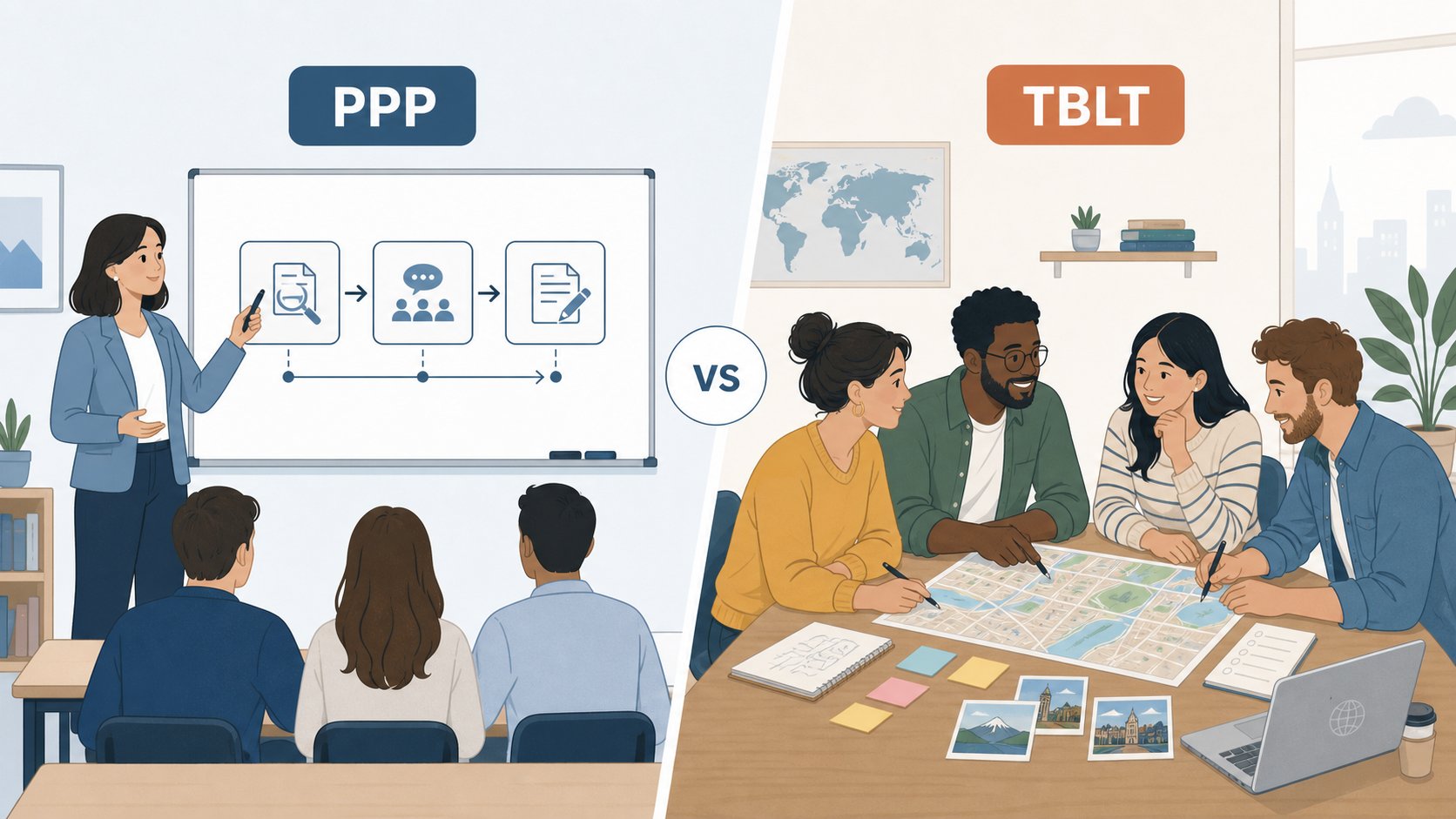
Looking at most ELT materials, the dominant paradigm is still the old reliable Presentation–Practice–Production (PPP) methodology. If you reduce this pattern to its basics, it boils down to:
restricted input (presentation) → (support) practice → restricted output (production).
Task-Based Language Teaching (TBLT) reverses the direction of the learning cycle:
pre-task (planning/modelling)→ output (task) → post-task (relevant input and support) → output (attempt task again).
TBT challenges the standardized approach of PPP, which begins with explicit teaching of a target form. TBLT, in contradestinction, begins with real-life, meaning-focused communication. In TBLT, learners attempt to achieve a concrete, non-linguistic outcome (for example, a negotiation, a parent–teacher meeting or resolving a complaint) and draw on whatever language resources they have to get there. The contrast is not just methodological; it reflects two different psycholinguistic philosophies about how language skills develop.
Synthetic vs Analytic Approaches
PPP represents a synthetic approach, in which language is broken into small, manageable units (for example, “today’s structure”) that learners are expected to recombine later into fluent communication. In the broader “focus on forms” tradition, lessons are typically sequenced around grammar points, vocabulary sets, or functions, each treated as a discrete item.
TBLT, by contrast, is an analytic approach, in which learners are engaged in holistic communicative activity from the outset, and any analysis of language (rules, patterns, forms) emerges from or supports that activity. Rather than breaking language into convenient target language nuggets for the learner, TBLT assumes that language development can occur incidentally through meaningful use. The type of language that students are mostly interested in, is the emergent language.
Forms vs Tasks
In PPP, the basic building block of planning is a linguistic form: the past simple, the first conditional, countable versus uncountable nouns, and so on. The lesson is designed to introduce, control, and finally “free up” that target form. A typical pattern might include a decontextualised presentation of a grammar rule, followed by highly controlled practice exercises, and finally a short “production” activity such as completing sentences or participating in a scripted dialogue using the rule that has just been presented.
Cognitively, this is problematic because in the practice and production phases learners are often not retrieving the rule from long-term memory or negotiating communication; instead, they are holding the rule in working memory and filling in blanks. The disadvantage is that the brain does not build the procedural networks that are required for rapid retrieval in real-time communication.
In TBLT, the primary unit is the task, a real-world, goal-oriented activity with a clear non-linguistic outcome. Examples include making a reservation, comparing options to choose a product, or solving a problem collaboratively. Language is viewed as a tool for accomplishing these tasks rather than an object of study in its own right, creating an immediate, authentic need to speak and supporting the development of robust neural networks through “learning by doing.”
Proactive vs Reactive Focus
PPP is proactive, so the teacher decides in advance which structure to teach and builds the lesson around it, regardless of whether learners are internally ready to acquire that item. Controlled practice aims to push the form into use through repetition and accuracy work.
TBLT is reactive in its grammar focus and learners first attempt the task, and only then does the teacher step in with a “focus on form” to address problems that emerge during task performance. This aligns instruction with the learner’s internal syllabus, responding to their language needs as they emerge, instead of imposing an external grammatical sequence.
What Counts as “Success”?
In a PPP lesson, success is often defined by how accurately learners can produce the target structure in controlled and semi-controlled contexts by the end of the lesson. The “can they say it correctly on cue?” test dominates, and because this is easy to assess, PPP remains a very attractive solution in many education systems.
TBLT measures success by task accomplishment: did learners actually achieve the communicative objective (for example, obtain the information, reach a decision, solve the problem, complete the transaction)? Accuracy and complexity still matter, but they are evaluated in the context of real communicative performance rather than decontextualised drills. This is closer to “learning by doing,” but it runs into a systemic challenge: the difficulty of assessing curricula built around numerous, individualized real-world tasks.
Psycholinguistic Foundations
PPP rests on skill-building models: the idea that explicit, declarative knowledge of rules can be transformed into implicit, procedural knowledge through repeated practice and automatization. The underlying assumption is that “explain → drill → use” mirrors how language skills are acquired.
TBLT draws on second language acquisition research suggesting that learners follow a relatively fixed “natural route” and that structures cannot simply be “taught into” the system on demand. From this perspective, input, interaction, and meaning-focused output are central, and explicit instruction works best when it is timed to support, not override, ongoing developmental processes.
Input and Materials
PPP lessons often rely on simplified, contrived dialogues or texts that are heavily “seeded” with the target structure to maximise exposure and practice opportunities. This can make language predictable and safe, but also less authentic and less representative of real-world discourse.
TBLT emphasises rich, elaborated input drawn from genuine target discourse (for example, real emails, recordings, and interactions), adapted for comprehensibility without stripping away the very features learners need to encounter to progress. The goal is to approximate the complexity of real communication while keeping the task doable.
Side-by-Side: PPP and TBLT
The table below summarises some of the key contrasts between PPP and TBLT in terms of focus, syllabus design, roles, and language use.
| Feature | PPP (Presentation–Practice–Production) | TBLT (Task-Based Language Teaching) |
|---|---|---|
| Focus | Language as an object; focus on forms | Language as a tool; focus on meaning; focus on form in context |
| Syllabus | Linguistic / synthetic, organised around structures | Task-based / analytic, organised around real-world tasks |
| Teacher role | Center-stage; controller of content and sequence | Facilitator; guide during and after task performance |
| Learner role | Largely reactive performer of pre-set language | Active agent and communicator, drawing on their own resources |
| Language use | Mechanical or pseudo-communicative practice | Authentic, spontaneous communication oriented to outcomes |
From your perspective as a trainer or materials writer which of these contrasts feels most consequential for your own course design decisions, and why?
Image: AI generated
Comments are closed