
Instructional Scaffolding refers to the support mechanisms and strategies used by teachers to help students progress through learning tasks and acquire new skills. It is the logical sequencing, the simple-to-complex progression of activities in a learning process. It is one of the most important principles of language training.
It’s like having training wheels on a bike – at first, you need a lot of support, but as you get better, you need less and less until you can ride all by yourself! Many of us have had this invigorating experience as a child: the moment we notice our parent is not holding the bike anymore, and we are actually cycling on our own steam.
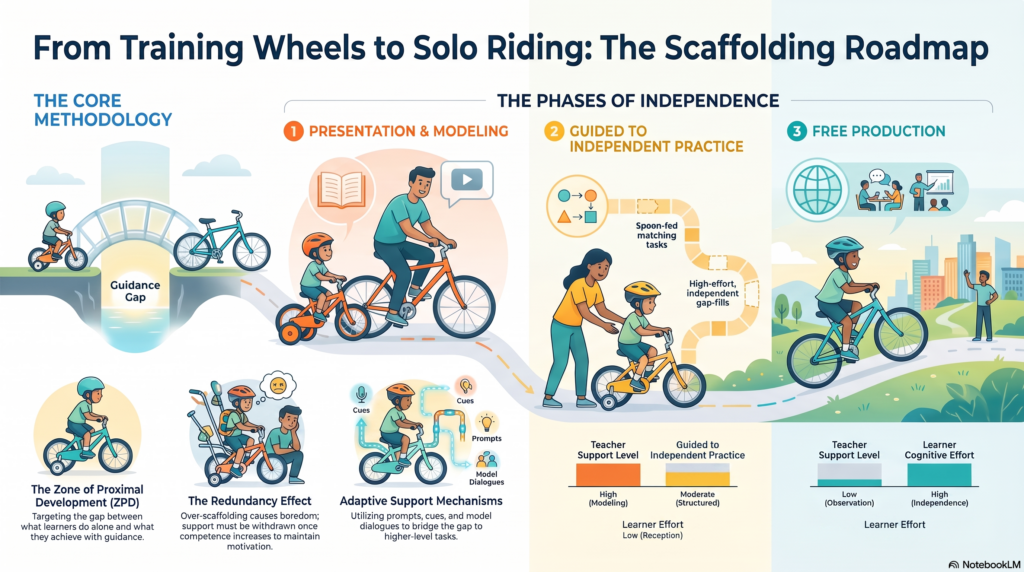
Scaffolding consists of providing explanations, tips, feedback and guidance. Trainers gradually remove support as learners become more independent and proficient. Trainers usually scaffold activities by breaking down complex linguistic tasks into manageable learning phases and activities. They model appropriate language use, provide prompts and cues, and systematically remove support as learners gain fluency. This idea is closely linked to the work of the Russian educational psychologist Lev Vygotsky, especially his concept of the Zone of Proximal Development (ZPD), which describes the gap between what a learner can do independently and what they can achieve with the support of a teacher or more capable peer. In practical terms, scaffolding works best when tasks are pitched just beyond the learner’s current level but remain achievable with guidance; as confidence and competence increase, that support is gradually withdrawn. In language teaching, this might involve giving learners sentence stems, model dialogues, guided questions, vocabulary support, or partially completed tasks before asking them to perform more freely and independently. It helps learners to engage with material at a level slightly beyond their current abilities. The goal is to enable learners to successfully complete tasks they would not be able to do on their own.
Let me give specific examples of how this is achieved in a typical B1+ language lesson. First, the trainer might begin with a Warm-up activity to activate prior knowledge and prepare students for the new content:
Discuss in pairs.
- What factors contribute to a good first impression in business?
- What impression do you think your company gives to clients?
- Have you ever had a negative first impression of a company? What caused it?
Then, the trainer can model the target language, providing clear explanations and testing comprehension. In the traditional Presentation-Practice-Production (PPP) language training methodology, this belongs firmly in the Presentation stage. This phase is often achieved with activities like dialogues, texts, comprehension questions, and the pre-teaching of vocabulary. A typical activity might look like this:
Read the article and answer the questions.
Our team always works hard to give the best service. We deliver on time, speak to clients politely, and try to show a strong and clear message in everything we do. We want people to know we are professional and reliable. These values help us build trust with customers.
- What are two things the team does for good service?
- What kind of image does the team want to present?
- How do these principles help with clients?
Learners are then given opportunities to practice the target language with scaffolded support, such as the dreaded gap-fill, matching sentence halves, or reordering sentences. This phase is often broken into two sections: Guided Practice and Independent Practice. In Guided Practice, all the language is spoon fed to the learners. This is definitely like having the training wheels on the bike.
Match the beginning of each sentence to the correct ending.
a) We aim to provide …
b) Our customers expect …
c) Our team always …
- … reliable, high-quality service.
- … delivers on time.
- … clear communication throughout the project.
At this stage, gap fills with options are often used. In Independent Practice, learners will have to provide content on their own. For example, instead of filling gaps with a given word, learners have to write it out independently. This is often called gap fill text, as they will have to guess the word, its spelling, and write it out. The task requires a lot more cognitive effort. Reducing scaffolding increases cognitive effort; however, it is done in a phased way, so students learn by doing, but with support that tapers off over time. Remember the analogy of learning to ride a bike. The adult slowly removes the supporting hand.
Complete the sentences about your own company.
- Our company specializes in…
- We take pride in…
- One way we ensure customer satisfaction is by…
As learners demonstrate increased proficiency, the trainer pares down the scaffolding to almost nothing. This is achieved through open-ended tasks, such as group discussions, role-plays, or free-writing activities. This is the Production phase of the lesson where the trainer steps back and lets the learners do the work.
Role-play: A networking event
You meet a potential client for the first time. Take turns to introduce yourselves, explain what your company does, and ask about the other person’s business.Student A: You are a product manager at an IT solutions firm. Talk about your role, company, and current projects.
Student B: You are looking for a new tech partner. Ask questions about services, reliability, and communication style.
The ultimate goal is for learners to internalize the language skills and be able to apply them independently in real-world contexts. Instructional scaffolding is a dynamic, adaptive and responsive approach. It is important to consider that you need to support learners at the right point, but later give them space to produce language. If the challenge level is not fine tuned to the learners, then there will be a redundancy effect where excessive scaffolding causes boredom and demotivation. It is like the over protective parent who refuses to let go.
Just like training a child to ride a bike, scaffolding is part of a clear roadmap for learning. It is framed by other good training methodologies and class management approaches. What is important to remember is that at the beginning, you will provide a lot of guidance, examples, and target language. You are giving the learners all the puzzle pieces, and their challenge level is low. You will be modelling to help learners understand how to use language effectively. As they get better, you need to know when to step back and reduce that support so they can work completely independently. If you get free production at the end of all that, you will know that you have succeeded and your students have achieved their learning goals.
Instructional Scaffolding
Test Your Knowledge
Scaffolding
Work through the quiz at your own pace.
Header image by RENE RAUSCHENBERGER from Pixabay
Infographic generated by NotebookLM
Comments are closed